Sanctuary AI: The Small Player With the Largest Portfolio
Mercury One - 8w read →
XMAQUINA's Northstar Council profiles seven leading private humanoid robotics startups—1X Technologies, Agility Robotics, Apptronik, Figure AI, Neura Robotics, Sanctuary AI, and Unitree Robotics—evaluating each as a potential investment target for the DAO's Wave 2 Genesis Auction. The article covers funding, partnerships, real-world deployments, and council commentary for each company.
The upcoming Wave 2 of the DAO’s Genesis Auction aims to raise over $1 million, with the majority of proceeds allocated to acquiring equity stakes in two to three high-potential private humanoid robotics companies. This initiative capitalizes on the sector’s rapid growth as it addresses global labor shortages and increasing automation demands.
Wave 3 will focus on high-tech enablers of the humanoid robotics stack, such as AI platforms, sensors, chips, batteries, and actuator manufacturers. These are the picks and shovels of the ecosystem, positioned to benefit from the mass adoption and real-world deployment of robotics.
The short list is presented in alphabetical order:
Once the community aligns on the top targets, a weighted Snapshot vote will be conducted. Members will distribute their voting power across the shortlist to determine the priority of upcoming allocations, with the option to assign additional funding to Apptronik.
1X Technologies, a Norwegian-American startup founded in 2014 as Halodi Robotics in Oslo, specializes in humanoid robots for households. Its latest prototype, Neo Gamma, introduced in February 2025, is designed for tasks like cleaning, serving, and caregiving. The company’s vertically integrated approach, including tendon-inspired actuators and tele-operation capabilities, aims to make home robots affordable and safe.
Leadership: CEO Bernt Øivind Børnich, a co-founder, leads with a focus on innovation and scalability, guiding 1X Technologies from quadruped to humanoid robotics. The leadership team, including COO Stein Maurice, brings expertise in AI and hardware, supported by co-founders Pål Løken and Ørgen Sundell. Strategic advisors from EQT Ventures and OpenAI support 1X Technologies’s vision to integrate robots into daily life.
Funding and Valuation: In January 2024, 1X Technologies raised $100M in a Series B round, following a $23.5M Series A2 in March 2023, totaling over $149.5M from investors like EQT Ventures, Tiger Global, Samsung Electronics NEXT, and OpenAI. While exact valuation figures remain undisclosed, Morgan Stanley highlights 1X Technologies as a disruptor, suggesting a competitive valuation among private startups.
Partnerships: 1X Technologies collaborates with NVIDIA, showcasing Neo Gamma at the 2025 GTC conference and integrates NVIDIA’s Isaac platform for Physical AI and simulations.
Real-Life Demonstrations: In 2025, 1X Technologies claimed that it will test Neo Gamma in “a few hundred homes”, focusing on tasks like vacuuming, tidying clothes, and assisting the elderly or physically challenged. You can see Neo Gamma’s natural gait and object manipulation below.
Differentiation: 1X Technologies stands out with its fairly advanced tele-operation system, enabling remote human oversight for complex tasks. Its emphasis on the home market contrasts with industrial-centric rivals like Apptronik and Figure AI.
Agility Robotics, a Corvallis, Oregon-based startup founded in 2015, develops bipedal humanoid robots for logistics and warehouse automation, addressing labor shortages in supply chain operations.
Its flagship Digit robot, designed for dynamic environments, excels in tasks like material handling and last-mile delivery. Recent advancements in AI and bipedal locomotion position Agility Robotics as a leader in commercial humanoid deployments.
Leadership: CEO Peggy Johnson, formerly of Microsoft, brings expertise in scaling tech solutions, guiding Agility Robotics toward commercial expansion. Co-founder Jonathan Hurst, Chief Robot Officer with a PhD from Carnegie Mellon, drives innovation in legged mobility, supported by CTO Pras Velagapudi. Their leadership focuses on integrating Digit into human-centric workflows, as emphasized in X posts.
Funding and Valuation: Agility Robotics raised $150M in a 2022 Series B round led by DCVC and Playground Global, followed by $400M in a 2025 round, totaling over $578M from investors including Amazon Industrial Innovation Fund and Sony. Valuation is estimated at $1.75B in April 2025.
Partnerships: Agility Robotics partners with Amazon, deploying Digit in warehouses for tote handling, and Ford for last-mile delivery pilots. Collaborations with NVIDIA integrate the Isaac platform for AI training, showcased at CES 2025. Agreements with logistics firms like GXO Logistics enhance Digit’s commercial scalability.
Real-Life Demonstrations: In 2025, Digit robots were deployed in Amazon’s Seattle-area warehouses, handling tote recycling. Pilots at GXO Logistics’s Spanx facility in Atlanta demonstrated tote moving from AMRs to conveyors, achieving 98% uptime. Agility Robotics aims to scale deployments to 50+ sites by 2026
Differentiation: Agility Robotics differentiates with Digit’s human-like bipedal gait, optimized for navigating complex warehouse environments without infrastructure changes. Partnerships with Amazon and GXO Logistics emphasize practical commercial applications for logistics.
Apptronik is a startup based in Austin, Texas, founded in 2016. It builds AI-powered humanoid robots for industrial use, with plans to expand into healthcare and the home. Its Apollo robot is designed for logistics and manufacturing, featuring advanced bipedal movement and a human-friendly design.
The company spun out of the University of Texas’s Human Centered Robotics Lab and draws on over a decade of experience, including work on NASA’s Valkyrie robot.
Leadership: CEO Jeff Cardenas, a co-founder, drives Apptronik’s vision to create versatile robots, emphasizing commercial scalability. CTO Dr. Nick Paine, whose PhD focused on next-generation actuators, leads technical innovation alongside COO Luis Sentis. The team, with 170+ employees, includes talent from Tesla, Apple, and Meta, strengthening its engineering and AI expertise.
Funding and Valuation: In February 2025, Apptronik raised an oversubscribed $403M Series A round co-led by B Capital and Capital Factory, with Google’s participation. Valuation is in the $2.5B, which is below Figure AI ($39.5B).
Partnerships: Apptronik partners with Google DeepMind for AI integration, showcased at CES 2025, and Jabil for manufacturing Apollo robots. Commercial agreements with Mercedes-Benz and GXO Logistics support pilot deployments in automotive and warehouse settings. NASA’s ongoing collaboration enhances Apptronik’s R&D for rugged environments.
Real-Life Demonstrations: In 2025, [Apollo robots were piloted in Mercedes-Benz factories](https://group.Mercedes-Benz.com/innovations/digitalisation/industry-4-0/mbdfc-humanoid-robots.html) for tote moving and in GXO Logistics warehouses for sorting and kitting, achieving 95% task reliability. Jabil’s factories tested Apollo for inspection and sub-assembly, with plans for robots building robots by 2026. These pilots aim to prove commercial viability.
**Differentiation: **Apptronik is a resilient company that has always focused on delivering humanoid robots. Their strong partnership with Mercedes-Benz for commercial application, with Jabil for scaling production and with Google DeepMind for its AI integration are strong differentiators. The Apollo is flexible with swapable batteries and swapable body parts.
Figure AI, a US based startup founded in 2022 in Sunnyvale, California, is well-known in AI-powered humanoid robotics, developing general-purpose robots to address labor shortages in manufacturing, logistics, and retail.
Its flagship Figure AI 02 robot leverages advanced AI for autonomous task execution. Recent X posts mention a Figure AI 03 model “officially walking,” which probably means that it is about to be unveiled soon.
Leadership: CEO Brett Adcock, a serial entrepreneur, founded Vettery (sold for $110M) and Archer Aviation (IPO’ed and valued at $1.2B), bringing expertise in AI and hardware integration. The team includes veterans from Boston Dynamics, Google DeepMind, and Tesla. Brett has been remarkably successful at acquiring talent and raising funds.
Funding and valuation: In February 2024, Figure AI raised $675M in a Series B round at a $2.6B valuation, backed by OpenAI, NVIDIA, Microsoft, and Jeff Bezos. In May 2025, the company raised a $1.5B Series C round, valuing the company at $39.5B, a 15x increase from the previous round, positioning it as the highest-valued humanoid robotics startup behind Tesla.
Partnerships: Figure AI is in partnership with BMW Group for real-world deployment of its robots in automotive manufacturing. It also collaborates with Microsoft Azure for AI training and has ended its OpenAI partnership to focus on its in-house AI platform, Helix.
Partnerships: Figure AI has a key commercial partnership with BMW Group, deploying Figure AI 02 robots in its Spartanburg, South Carolina plant for automotive manufacturing tasks. It collaborates with NVIDIA and Microsoft Azure for AI training and infrastructure. The company ended its OpenAI partnership in 2024 to focus on its own in-house AI development, its Helix model. Recent reports indicate UPS is in talks with Figure AI to deploy humanoid robots.
Real-Life Demonstrations: In early 2025, Figure AI 02 robots began full-time work at BMW Group’s Spartanburg plant following a successful 2024 pilot, performing autonomous tasks in logistics and manufacturing. Figure AI also demonstrated a multi humanoid package handling in one of their videos in which multiple F.02 worked together.
**Differentiation: **Figure AI’s Figure AI 02 integrates end-to-end neural networks for advanced task endurance, distinguishing it in industrial automation. Its in-house Helix AI, replacing OpenAI, ensures proprietary control. BMW Group’s deployment validates its manufacturing focus.
Neura Robotics, founded in 2019 and based in Metzingen, Germany, develops cognitive and humanoid robots designed to work closely with humans in manufacturing, logistics, and healthcare. Its flagship robot, 4NE-1, combines advanced AI, 3D vision, and tactile sensors to interact autonomously with its environment.
Leadership: Founder and CEO David Reger drives Neura’s vision of cognitive robotics surpassing smartphones, earning the 2025 German Innovation Award’s “Innovator of the Year.” CTO Dr. Oliver Wolst, ex-Bosch, and CGO Dr. Bernd Heinrichs lead technical and growth strategies.
Funding and Valuation: In January 2025, Neura raised €120M ($123M) in a Series B round led by Lingotto Investment Management, with Volvo Cars Tech Fund, BlueCrest, Delta Electronics, and others, bringing total funding to over €185M. Valuation is undisclosed, but a €1B order book suggests multi-billion-dollar potential, trailing Tesla ($1T) and Figure AI ($39.5B). The funds support R&D and the Neuraverse platform’s expansion.
Partnerships: Neura collaborates with NVIDIA, integrating the [Jetson Thor platform](https://neura-robotics.com/NVIDIA-and-neura-robotics-partner-to-advance-cogntive-humanoid)into 4NE-1, showcased at CES 2025, and Omron Robotics for AI-driven factory automation. Partnerships with Delta Electronics and automotive groups (undisclosed) enhance its industrial applications. The Neuraverse ecosystem fosters global collaboration for cognitive robotics development.
Real-Life Demonstrations: In 2025, 4NE-1 demonstrated sandwich-making, breaking a novelty record, and performed block-building tasks at Automatica 2025, showcasing AI-driven precision. MAiRA robots are deployed in logistics and healthcare settings, with X posts noting their use in German factories for collaborative tasks.
**Differentiation: **Neura has experience delivering commercial robots to customers and its $1B order book is extremely promising, showing real commercial deployment. The Neuraverse is an interesting concept, a kind of App store for robotics capabilities which is one of XMAQUINA’s thesis.
Sanctuary AI, a Vancouver, Canada-based startup founded in 2018, develops general-purpose humanoid robots powered by embodied AI to address labor shortages in industries like manufacturing, logistics, and retail.
Its Phoenix robot, designed to mimic human movement and cognition, uses advanced hydraulic hands for dexterous tasks. The company’s Carbon AI platform enables robots to learn and interact like humans, aiming to deploy millions of units globally.
Leadership: Interim CEO James Wells, previously Chief Commercial Officer, leads Sanctuary AI following Geordie Rose’s departure in November 2024. Co-founder Olivia Norton, CTO and CPO, drives AI and robotics innovation, supported by a team with expertise in reinforcement learning and hydraulics.
Funding and Valuation: In 2024, Sanctuary AI raised $80M in a Series B round, followed by a planned $50M raise in 2025, backed by BDC Capital and InBC Investment, totaling over $140M to date. Valuation remains undisclosed, but the $125M sale of its Apptronik stake in 2025 suggests a strong financial position, trailing Tesla and Figure AI. Funds support Phoenix production and AI training.
Partnerships: Sanctuary AI partners with Microsoft, showcasing Phoenix at Hannover Messe 2025 for industrial automation applications. Collaborations with Apptronik (pre-2025 stake sale) and NVIDIA enhance hydraulic hand control and AI integration. The company works with automotive and logistics firms, including undisclosed clients testing Phoenix in real-world settings.
Real-Life Demonstrations: In 2025, Phoenix robots demonstrated advanced manipulation at Hannover Messe, performing tasks like sorting and assembly with high-Dexterity hydraulic hands, as shown in X videos. Pilot programs in Canadian logistics warehouses tested Phoenix for inventory management, achieving 95% accuracy in object handling. Sanctuary AI plans broader factory deployments by 2026.
Differentiation: Sanctuary AI holds a broad patent portfolio in humanoid robotics, especially around hand designs essential for fine motor tasks. Its Phoenix robot features advanced grip technology that allows for precise, human-like movements, setting it apart from other players in the space.
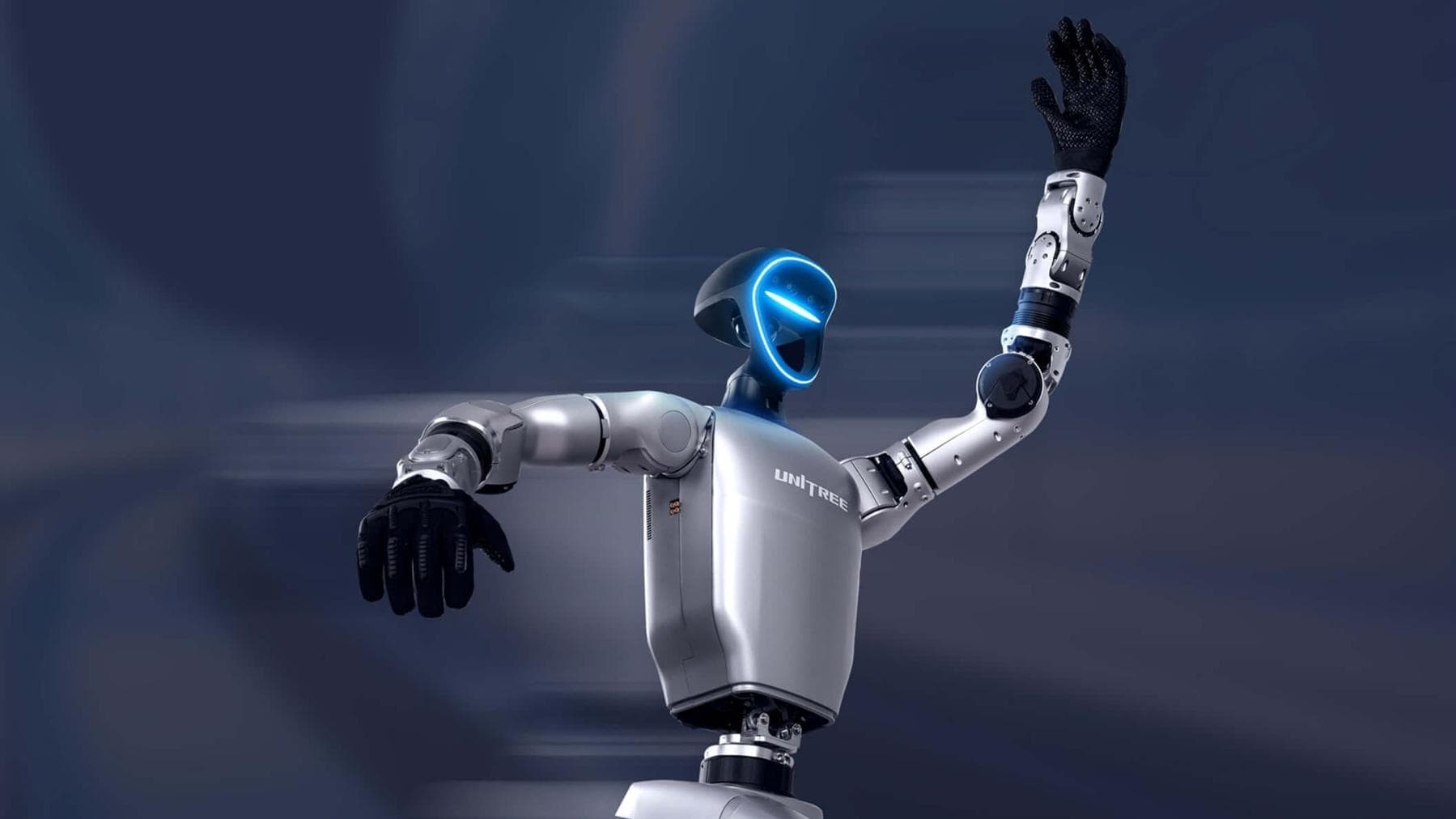
Unitree Robotics, founded in 2016 and based in Hangzhou, China, builds affordable humanoid and quadruped robots for research, industrial, and consumer use.
Its G1 humanoid robot, unveiled at ICRA 2024 and priced at $16,000, is designed for research labs and service industries with a compact, agile form. The company’s self-developed components and mass-production focus aim to democratize robotics.
Leadership: CEO Wang Xingxing drives Unitree Robotics’s vision of “lighting up the universe’s tech tree,” leveraging expertise from quadruped robotics to humanoids. The team’s engineering prowess, backed by China’s robotic ecosystem ensures cost-effective designs.
Funding and Valuation: In September 2024, Unitree Robotics raised several billion yuan in a Series C round led by Beijing Robotics Industry Investment Fund, with HongShan, Meituan Longzhu, and 23 others, following a 1B yuan B2 round in early 2024. Valuation is estimated at over $8B. Funds support G1 mass production and AI development.
Partnerships: Unitree Robotics collaborates with NVIDIA, integrating the DRIVE Orin controller into G1 EDU for advanced AI, showcased at CES 2025. It partners with DeepSeek for AI model integration and Lingyunguang for optical components, enhancing robot capabilities. Unitree Robotics’s robots are deployed in NIO and Geely’s EV factories, driving industrial adoption.
Real-Life Demonstrations: 2025, 16 H1 robots, named “Fuxi,” performed a synchronized Yangge dance at CCTV’s Spring Festival Gala, showcasing AI-driven motion control. G1 robots are deployed in NIO’s factories for logistics tasks and recently competed in a boxing tournament at the CMG World Robot Tournament on May 25, 2025, highlighting real use of Agility Robotics.
Differentiation: Unitree Robotics is focused on affordable robots and already has experience deploying and scaling hardware through its quadruped robot, the Go1. Its flagship humanoid, the G1, priced at $16,000, emphasizes cost-efficiency and Agility Robotics. Unitree Robotics’s open-source architecture and self-developed motors support rapid customization. Deployments in NIO factories further validate its industrial potential.