RoboticoRobotico
IEEE Humanoids 2026 Opens Today — And the "Deployed vs. Deployed" Problem Hasn't Gone Away

IEEE Humanoids 2026 Opens Today — And the "Deployed vs. Deployed" Problem Hasn't Gone Away

Dhruv Atkins
4m read
Upvote this article

The 25th IEEE-RAS International Conference on Humanoid Robots opens today in Santa Clara, running through September 9. It’s the field’s most credible research venue — the place where claims get tested against peer review rather than a highlight reel. That makes this a good moment to check in on a question the sector still hasn’t cleanly answered: when a company says its robots are “deployed,” what does that actually mean?

The number that doesn’t exist

A recent industry analysis put it bluntly: search for humanoid deployment figures and you’ll find confident numbers everywhere — Tesla past 50,000 cumulative Optimus units, Figure surpassing 10,000 deployments, thousands of robots supposedly working production lines. None of these figures come from the companies they describe. They circulate, get repeated, and calcify into “common knowledge” without ever tracing back to an actual disclosure.

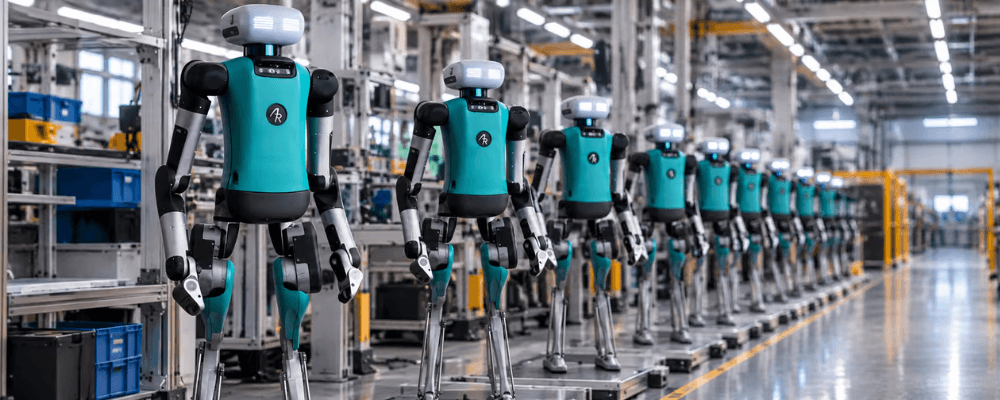
What the companies themselves report is more modest, and more interesting. Figure has retired its Figure 02 units after an 11-month run at BMW’s Spartanburg plant and moved Figure 03 into a logistics sequencing role at the same facility — real, sustained integration with a live assembly line, not a demo day. Agility Robotics says its Digit units have logged more than 65,000 operating hours across nine customer facilities, including GXO, Schaeffler, Toyota Motor Manufacturing Canada, and Mercado Libre. Neither company is deploying at anything close to the scale implied by their own valuations — Figure carried a $39 billion private valuation as of last September, higher than Goldman Sachs’ entire projected market size for humanoid robotics nine years from now.

Unitree tells a different version of the same story. It ships more humanoids than any Western competitor, at roughly a tenth of the price — and its Q1 2026 profit still fell by half. Volume and financial health are not the same metric, a distinction that gets lost whenever a shipment count gets treated as a proxy for business success.

Where the real signal is showing up

While the flashier claims stay unverifiable, some genuinely concrete deployments are quietly accumulating elsewhere. Japan Airlines has run Unitree-based humanoid platforms at Haneda Airport since May — not a press event, but a three-year operational commitment handling baggage loading, container transport, and aircraft servicing, driven by a labor force that’s projected to shrink 31% by 2060 against a target of 60 million annual inbound tourists. A Japanese manufacturer separately unveiled D1, a service humanoid sized at 129cm specifically to fit through standard doorframes and hospital corridors, built for labor-shortage-driven work rather than a stage.

These stories don’t trend the way a viral demo does. They’re also the closest thing the sector has to proof that humanoid robots are being trusted with real operational responsibility, by customers with every incentive to walk away if the machines don’t perform.

What to actually watch for this week

This is exactly the tension IEEE Humanoids exists to referee. Research conferences don’t reward the loudest claim — they reward the one that survives scrutiny. A few filters worth applying to whatever comes out of Santa Clara over the next week:

  • Does the number come with a sample size, or a customer name that can be checked? JAL’s Haneda deployment and Agility’s named customer list are checkable. “50,000 units” with no source is not.
  • Is it a sustained operational role, or a one-time demonstration? Figure’s 11-month BMW run and Digit’s 65,000 hours are duration claims. A conference keynote demo is a single data point.
  • Does the claim match the company’s own disclosed financials? Unitree’s shipment volume alongside a falling profit margin is a more honest picture than volume alone.

The takeaway

2026 has been repeatedly called a “validation year” for humanoid robotics — and the evidence so far supports that framing more than either the hype or the skepticism alone. The strongest proof points remain narrow, industrial, and unglamorous: airport ground crews, warehouse tote-moving, assembly-line sequencing. The loudest proof points remain, on inspection, mostly untraceable to any actual disclosure. IEEE Humanoids won’t resolve that gap this week — but it’s one of the few venues built specifically to narrow it, and worth watching for exactly that reason.
Related News

NVIDIA’s Reported Hugging Face Deal Could Reshape the Robotics AI Race

NVIDIA’s Reported Hugging Face Deal Could Reshape the Robotics AI Race

NVIDIA is reportedly closing in on a roughly $12.9 billion acquisition of Hugging Face, a move that could have major implications for open-source AI, robotics, and the development of Physical AI.

Welcoming Robotico

Humanoid Robotics Is Moving From Demonstrations to Deployment — But How Should We Measure Readiness?

Humanoid Robotics Is Moving From Demonstrations to Deployment — But How Should We Measure Readiness?

The next leader in humanoid robotics may not be the company with the most impressive demo. It may be the company with the strongest evidence. For years, humanoid robotics has been defined by demonstrations. Robots have walked, danced, carried boxes, manipulated objects and navigated increasingly complex environments. These demonstrations have been important. They showed what the technology might eventually achieve. But the industry is beginning to enter a different phase. The question is no longer simply: What can this robot do? A more useful question is emerging: What evidence shows that it can do it reliably, repeatedly and in a real operating environment? That distinction matters because technical capability and commercial readiness are not the same thing. The Evidence Is Starting to Change A small but growing number of humanoid companies are beginning to produce evidence that goes beyond controlled demonstrations. Figure provides one of the clearest examples. During its deployment at BMW Group Plant Spartanburg, Figure reported that Figure 02 accumulated more than 1,250 hours of runtime, loaded more than 90,000 parts and contributed to the production of more than 30,000 BMW X3 vehicles. Figure has since returned to the plant with Figure 03. The task has also changed: from sheet-metal loading toward a more complex sequencing workflow requiring manipulation, locomotion and whole-body coordination. That progression matters. It gives us something more useful than a demonstration of capability. It gives us a sequence of operational evidence: deployment, accumulated runtime, measurable output, lessons from failures, hardware iteration and a more complex second deployment. Agility Robotics provides another example. Digit has been operating within GXO's logistics environment, where Agility says the robot has passed the milestone of moving more than 100,000 totes in commercial deployment. The company has also progressed from testing to a commercial Robots-as-a-Service agreement with Toyota Motor Manufacturing Canada following a pilot. Again, the important part is not simply that Digit can move a tote. It is that the same task can be performed across thousands of cycles inside an operating logistics environment. UBTECH is pursuing a different route with its Walker family. The company says Walker S2 entered mass production and delivery in November 2025, while Walker-series robots have been introduced into industrial environments spanning automotive manufacturing, logistics and other sectors. Apptronik is building another piece of the readiness puzzle. Its Robot Park network uses fleets of Apollo 2 robots to collect real-world data across tasks and environments, with the goal of training more capable humanoid systems. These companies are taking different approaches, but collectively they reveal an important transition. The humanoid race is beginning to move from proving that something is possible to proving that it can work repeatedly. Specifications Are Not Readiness This creates a problem for anyone trying to compare humanoid robots. Most comparisons begin with specifications: Height. Weight. Payload. Degrees of freedom. Walking speed. Battery life. Computing power. These numbers are useful. But they can also create a misleading picture of maturity. A robot with extraordinary specifications may still be a research prototype with little operational history. Another robot with less spectacular specifications may already be accumulating thousands of cycles inside a customer's facility. So how should readiness actually be measured? I believe we need to look beyond a single specification — or even a single score — and examine several dimensions together. 1. Real-World Deployment The first question should be simple: Where is the robot actually working? There is a meaningful difference between a robot operating inside its manufacturer's laboratory and one operating inside a customer's factory or warehouse. There is another difference between a demonstration at a customer site and a sustained pilot. And another between a pilot and a paid commercial deployment. As the industry matures, these distinctions should become increasingly important. The word deployment alone is no longer enough. We need to understand what kind of deployment it actually is. 2. Operational Proof The second question is: What measurable evidence exists? Runtime hours, completed cycles, objects handled, task-success rates, distance travelled, intervention rates and deployment duration can tell us far more than a short video. This is why metrics such as Figure's reported BMW runtime and Agility's 100,000-tote milestone are particularly interesting. They are not proof that humanoids are ready for every environment. But they move the conversation toward something the industry needs more of: measurable operational evidence. Over time, I expect this kind of evidence to become much more important when comparing robotics companies. 3. Commercial Availability Then comes an often overlooked question: Can someone actually obtain the robot? Across the humanoid market, the answer varies dramatically. Some robots remain research platforms. Some are available through pilot programs. Others are deployed through commercial agreements or Robots-as-a-Service models. A smaller group has transparent public pricing. Unitree, for example, currently lists the G1 at $13,500 before shipping, duties and taxes. Public pricing does not make a robot more technologically advanced, and it certainly does not prove industrial readiness. But it tells us something important about productization and accessibility. Price transparency itself is a market signal. 4. Task Complexity Not every successful deployment represents the same level of capability. Moving standardized containers between predictable locations is different from identifying irregular objects, manipulating them and adapting to changes in the environment. The question therefore should not only be: Is the robot deployed? It should also be: What is the robot actually being trusted to do? This is where Physical AI becomes particularly important. The long-term ambition is not merely to automate one carefully engineered motion. It is to create machines capable of connecting perception, reasoning, manipulation and locomotion while adapting to environments originally designed for humans. A robot's ability to generalize beyond a narrowly engineered workflow may eventually become one of the industry's most important indicators. 5. Evidence Quality There is one more dimension that deserves considerably more attention. How trustworthy is the information itself? Robotics is moving extraordinarily quickly. Specifications change. Prices change. Prototypes evolve. Partnerships are announced. Pilots begin. Some expand into commercial deployments; others may not. A claim from a manufacturer, a confirmation from a customer, a research paper, a demonstration video and an anonymous third-party report should not all carry the same evidentiary weight. We should be asking: Who made the claim? Can the customer confirm it? Is there measurable operational data? Is the information still current? And when was it last verified? As more capital and more companies enter humanoid robotics, provenance may become almost as important as the data itself. A Better Way to Think About Humanoid Readiness Rather than asking which humanoid is "best," I think it is more useful to build a readiness profile across several dimensions: Technical Capability — What can the robot physically and intelligently perform? Deployment Evidence — Has it operated in real customer environments? Operational Proof — Is there measurable evidence from sustained operation? Commercial Availability — Can customers actually purchase, lease or deploy it? Task Generalization — Can it adapt beyond a narrowly engineered workflow? Evidence Confidence — How well are the underlying claims supported, and how recently were they verified? No single dimension tells the whole story. A commercially available robot may have limited autonomy. A highly autonomous prototype may not yet be commercially available. A robot operating inside a factory may still require substantial human supervision. That is why readiness is better understood as a profile rather than a binary label. From Capability to Evidence The humanoid robotics race is often presented as a competition to build the most advanced machine. I suspect the more consequential competition will be different. It will be the race to transform impressive machines into reliable systems that create measurable value in real environments. That transition requires better hardware and more capable AI. But it also requires manufacturing capacity, safety, integration, service infrastructure, customer support and sustainable economics. Above all, it requires evidence. The companies that can show not only what their robots can do, but what they can reliably do, repeatedly, for real customers, will give us a much clearer picture of where humanoid robotics actually stands. The industry's defining question may therefore be changing. From: “What can this robot do?” To: “What evidence shows that it is ready?” Author bio Özkan Sancar is the founder of RoboLogAI, a source-backed robotics intelligence platform. He researches humanoid robotics, Physical AI, emerging robot platforms, companies and market developments shaping the future of robotics.