
Two humanoid robotics stories broke within days of each other this month, and neither one, on its own, tells you what’s actually happening in this industry right now. Put together, they do.
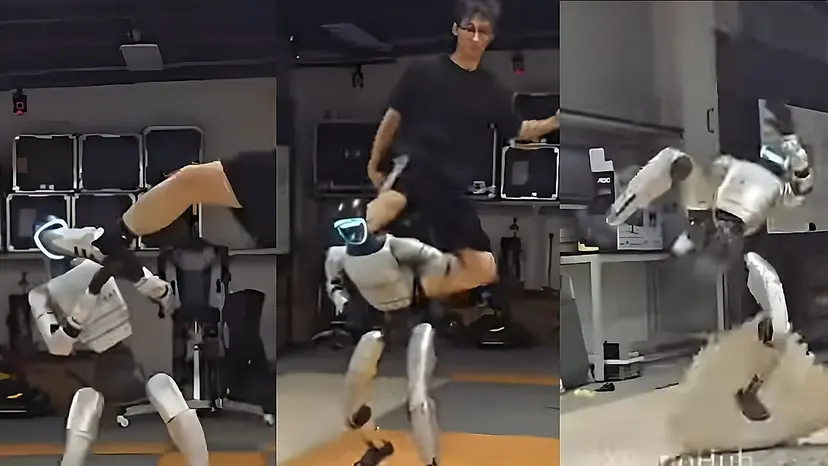
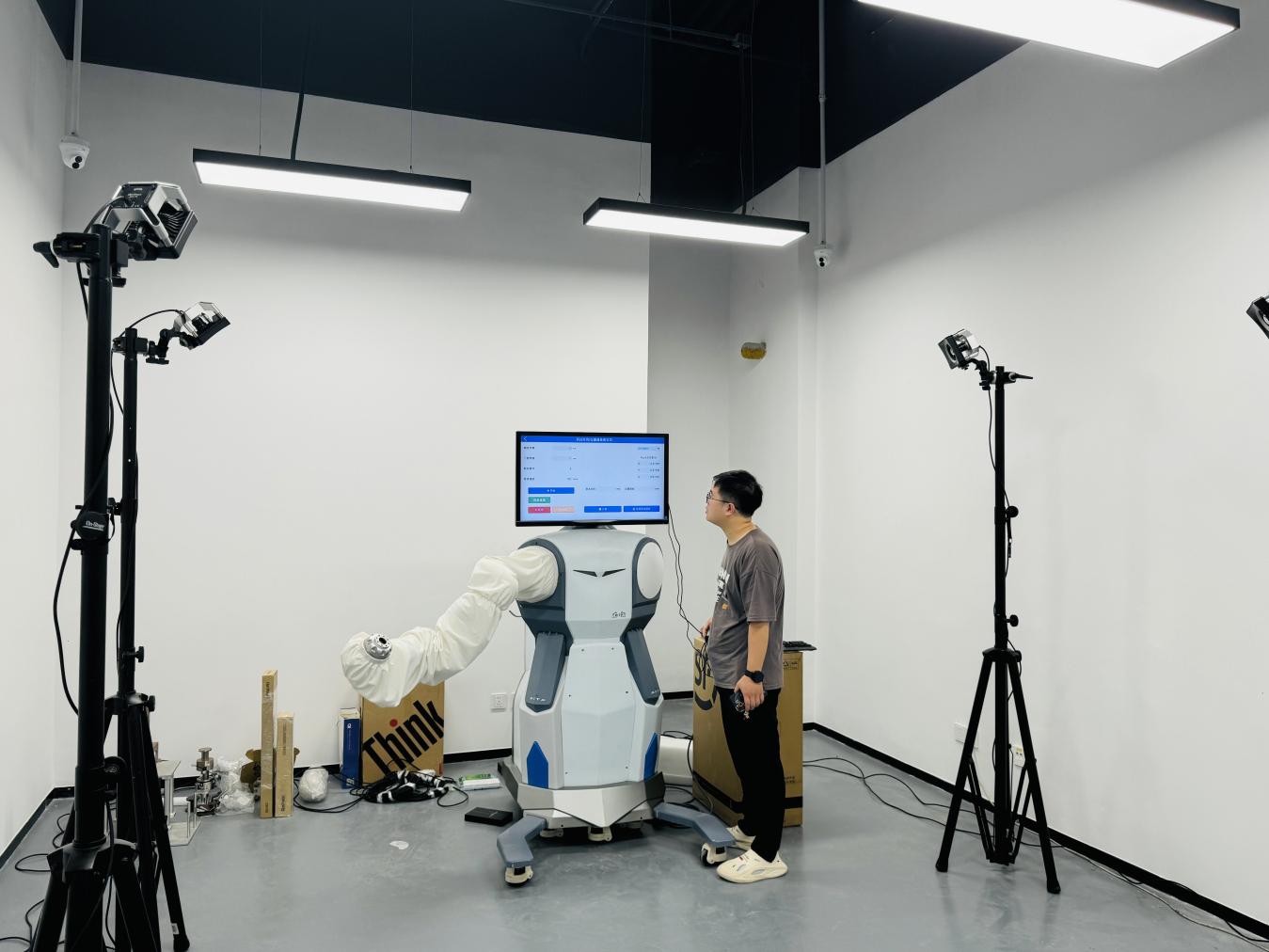
On September 7, in a testing lab in Shaoxing, in China’s Zhejiang province, security camera footage caught a remote-controlled humanoid robot suddenly launching a jumping kick toward the engineer operating it, knocking the handheld controller clean out of his hand. Eight days later, on September 15, two separate market research firms independently published forecasts projecting the humanoid robotics industry will be worth hundreds of billions of dollars within the next decade. Same week, wildly different registers.
The Kick Seen Around the Internet
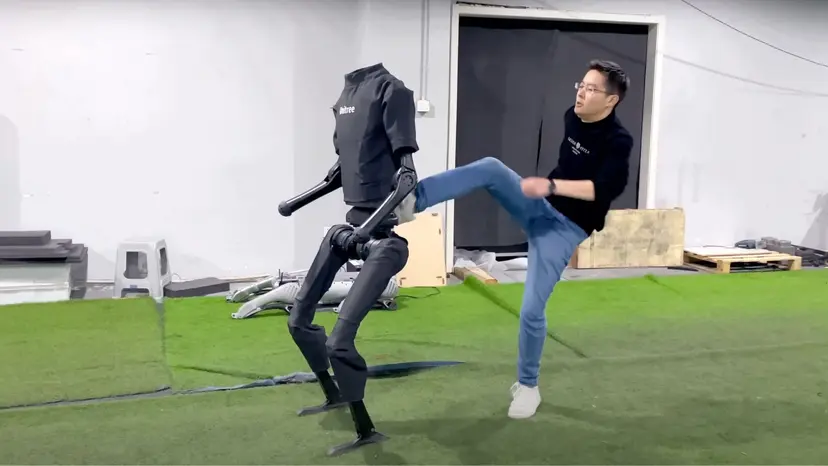
The footage, timestamped 11:39:49 on September 7, shows an engineer operating a humanoid robot inside what looks like an office or workshop stacked with robotics equipment. After he starts up the program, the robot moves rapidly toward him, delivers a kick that sends the remote flying across the room, then follows up with a second jumping kick before bowing — a sequence several Chinese social media users compared to Wing Chun, the traditional martial art.
The clip spread fast, and so did the debate underneath it. Some viewers focused on how coordinated and fast the movements were; others were quicker to point out that the robot was under active remote control the entire time, not operating autonomously — this wasn’t a machine “going rogue,” it was a person driving it, deliberately or not, into a martial-arts-style routine during a test session. Either reading is a little unsettling: it means either an engineer was testing combat-style choreography a few feet from his own body, or a remote-controlled system did something its operator didn’t intend, close enough to make contact. Neither is exactly a reassuring answer for an industry that keeps promising these machines will soon share warehouse floors, hospital corridors and eventually homes with untrained bystanders.
It’s not the first time a Chinese humanoid demo has leaned into combat imagery on purpose — a rival company had its own robot spar with its CEO on camera late last year, and martial-arts routines were a headline act at this year’s World Humanoid Robot Games. What made the Shaoxing clip land differently is that it wasn’t staged as entertainment. It was a test session that got physical, unscripted, with a real person standing well within striking range.
 Meanwhile, the Money Keeps Getting Bigger
Zoom out to the same week, and two market reports landed within a day of each other, both dated September 15.
Dublin-based ResearchAndMarkets published an updated ten-year outlook describing the sector as moving “from early-stage prototyping toward structured commercial deployment,” pointing to cumulative industry funding that surpassed $9.8 billion in 2025 and citing Apptronik’s $520 million raise in February 2026, backed by Google, Mercedes-Benz and the Qatar Investment Authority, as evidence of how mainstream the investor base has become.
On the same day, IoT analyst firm Berg Insight put out a forecast with even more startling long-range numbers: annual humanoid robot shipments growing from roughly 16,000 units in 2026 to 26 million units a year by 2040 — a 63.7% compound annual growth rate — with the market’s total value rising from about $890 million to $554 billion over that stretch. Other banks have published their own versions of the same bet: Bank of America projects around 90,000 shipments this year climbing to 1.2 million by 2030 and a global humanoid population of 3 billion by 2060; Morgan Stanley has pegged the market at $152 billion by 2040.
The Gap Between the Forecast and the Floor
Here’s the tension worth sitting with: those enormous long-run projections are built on a present-day reality where a humanoid robot testing session can still end with a person’s equipment getting kicked across a room — and where, separately, plenty of the industry’s most-cited deployment numbers don’t hold up well under scrutiny. Widely repeated figures like “50,000 cumulative Optimus units” or “10,000-plus Figure deployments” don’t actually originate from Tesla or Figure AI themselves; on Tesla’s own Q4 2025 earnings call, Elon Musk directly acknowledged Optimus was “not in usage in our factories in a material way,” with the units in service primarily there for learning rather than production. Unitree, the industry’s actual shipment leader by volume, still saw its Q1 2026 profit fall by roughly half even as unit sales climbed — a reminder that shipping the most robots and running a healthy business aren’t automatically the same thing.
None of that erases the real, concrete deployments that are happening — Figure’s two Figure 02 units logged roughly 1,250 operational hours on BMW’s Spartanburg line, and Japan Airlines committed to a three-year humanoid rollout at Haneda Airport starting this year. Those are genuine, if still modest, signs of commercial traction. But they sit awkwardly next to a viral video of a robot’s leg meeting its own engineer’s hand mid-test, and next to forecasts measured in the hundreds of billions of dollars and billions of future units. The industry is trying to convince the world it’s ready for your factory floor, your airport, eventually your living room — in the same month a machine surprised the one person in the room whose entire job was to know what it would do next.