
While robotics companies compete to build increasingly sophisticated humanoids, Telexistence is taking a different approach: developing a robot designed to perform one repetitive task exceptionally well. Its upcoming FamilyMart rollout suggests that specialized automation could reach commercial scale faster than general-purpose humanoids.
The robotics industry has become increasingly focused on humanoid machines.
Companies are investing billions in robots designed to walk, manipulate objects and eventually perform a wide variety of human tasks. The long-term vision is ambitious: machines that can work in factories, warehouses, retail stores and potentially even people’s homes.
But while the industry focuses on building robots that can do almost everything, another approach is already finding its way into everyday business operations.
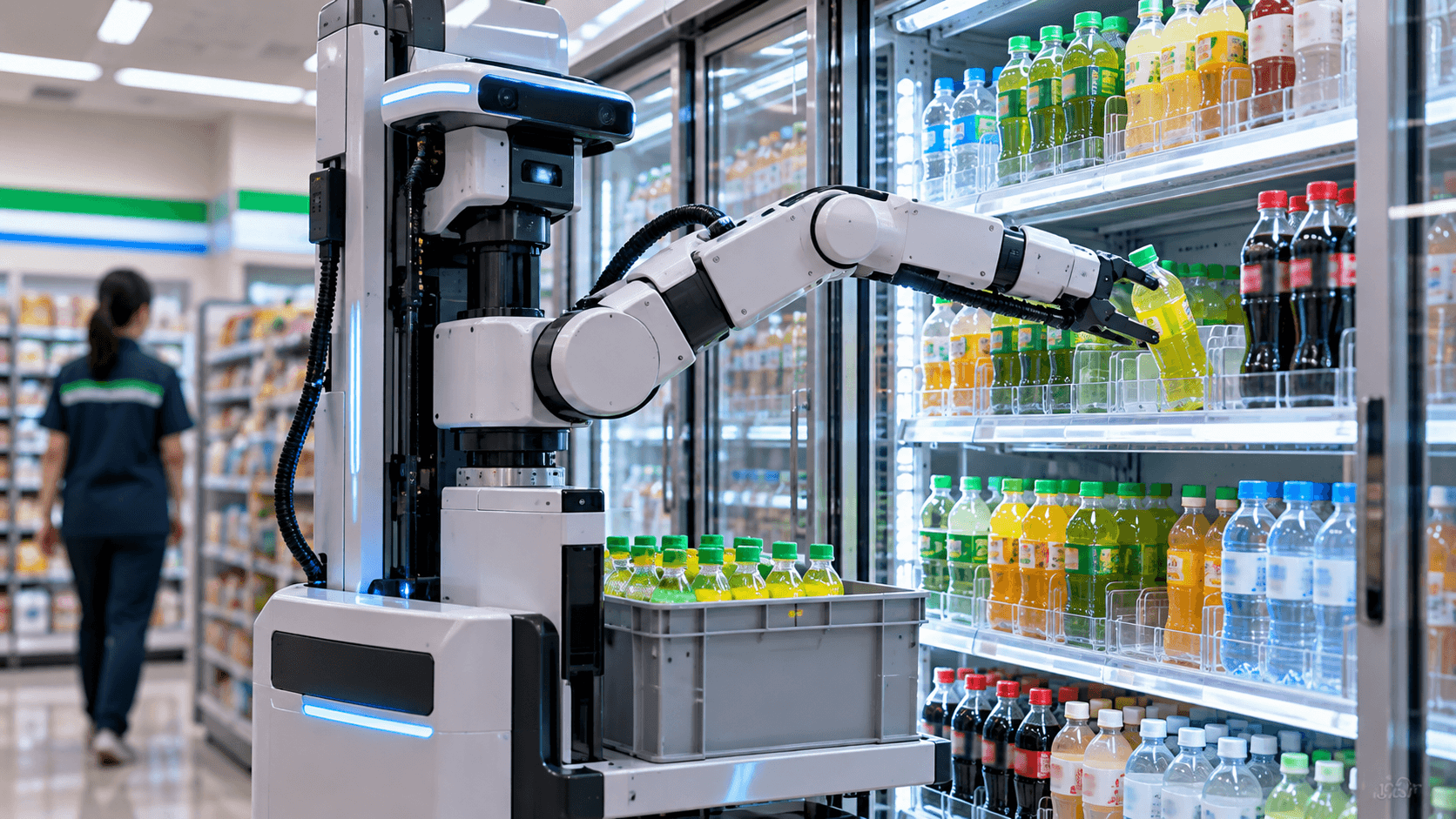
Japanese robotics company Telexistence is preparing to expand its TX GHOST beverage-restocking robot across FamilyMart stores throughout Japan, with phased deployment scheduled to begin in January 2027.
The system is designed to automate one specific activity: moving drinks from inventory storage onto retail shelves.
That might not sound as impressive as a humanoid performing complex movements. However, the commercial implications could be considerably more important than they initially appear.
A Robot Designed Around One Business Problem
The TX GHOST system was developed to address a repetitive problem in convenience stores.
Employees regularly need to organize beverage deliveries, manage inventory inside refrigerated storage areas and replenish products on customer-facing shelves.
The work is physically repetitive and takes time away from other store responsibilities.
Telexistence has spent several years developing a solution with FamilyMart, with their collaboration and store trials dating back to 2020.
The resulting system combines two technologies:
TX GHOST: An AI-powered robot that automatically places beverages onto retail shelves inside refrigerated storage areas.
Smart Shelf: A digital inventory system that tracks product locations and quantities, helping determine which items need replenishment.
According to Telexistence, TX GHOST can operate around the clock and stock up to approximately 1,800 items per day.
The robot also analyzes store sales information to prioritize popular products, potentially reducing missed sales opportunities caused by empty shelves.
More importantly, FamilyMart reports that early deployment stores achieved approximately 70% less daily workload associated with inventory management and beverage replenishment.
That is a significant operational improvement for a task performed repeatedly across thousands of retail locations.
Why This Could Be a Better Commercial Strategy Than Building Humanoids
The biggest challenge facing general-purpose humanoid robots is not necessarily their ability to perform individual tasks.
It is their ability to perform those tasks reliably across different environments.
A humanoid working in an automotive factory may encounter entirely different requirements from one operating in a warehouse or retail store.
Every new environment introduces additional challenges involving navigation, object recognition, manipulation, safety and task execution.
Specialized robots avoid much of that complexity.
TX GHOST does not need to understand how to operate an entire convenience store.
It needs to understand beverage inventory, identify products, retrieve them and place them correctly.
This creates a much narrower engineering problem.
The company can optimize its hardware, software and AI around a defined workflow rather than attempting to build a machine capable of handling an unlimited number of activities.
That also makes performance easier to measure.
How many beverages can the robot stock?
How frequently does it require assistance?
How much employee time does it save?
How reliably can it maintain shelf availability?
These are questions retailers can use to evaluate whether automation makes financial sense.
For humanoid developers, achieving similar commercial clarity across multiple tasks remains a much larger challenge.
The 70% Figure Is Interesting, but the Economics Still Matter
FamilyMart’s reported 70% reduction is an encouraging result, but it should be interpreted carefully.
The figure relates to the targeted inventory and beverage-replenishment workload, not a 70% reduction in all employee working hours or total store staffing.
Employees still need to replenish the Smart Shelf with incoming products.
The robot handles the subsequent stocking process.
That distinction is important because successful automation does not necessarily eliminate an entire job.
Instead, it removes specific repetitive activities from an existing workflow.
For retailers, this can create opportunities to redirect employees toward customer service, store presentation and other responsibilities that require human judgment.
However, the financial case still needs to be demonstrated.
Neither company has publicly disclosed the robot’s full deployment cost, the number of stores included in the initial rollout or the expected payback period for individual locations.
Without those figures, the reported workload reduction cannot automatically be translated into a specific financial return.
The next important milestone will be determining whether the productivity improvements justify the cost of installing and maintaining the system across a much larger retail network.
Human Assistance Is Still Part of the System
There is another interesting detail that deserves attention.
Despite being marketed as an AI-powered robot, TX GHOST does not operate completely independently in every situation.
Telexistence says most stocking activities are performed autonomously, but unusual situations can require assistance from remote human operators.
For example, if a beverage falls over and needs to be repositioned, an operator can intervene through teleoperation.
At first glance, this might appear to be a limitation.
However, it also reveals an important strategy for developing Physical AI.
Rather than waiting until a robot can handle every possible situation independently, Telexistence uses human assistance to keep the system operating while collecting additional real-world movement data.
The company says these interactions help train its own robot foundation models, gradually expanding the range of situations the system can handle autonomously.
This creates a feedback loop:
- The robot performs its normal tasks autonomously.
- Human operators assist when unexpected situations occur.
- The system collects additional real-world operating data.
- That data supports improvements to the robot’s AI.
- Future versions can potentially handle more situations without intervention.
The long-term objective is to reduce the amount of human assistance required as the robot gains experience.
This approach is particularly interesting because it treats teleoperation as part of the development process rather than simply as an emergency backup.
The real question will be whether the frequency and cost of human interventions decline as deployments expand.
Retail Could Become an Important Robotics Market
Factories and warehouses have traditionally attracted much of the attention surrounding industrial automation.
Retail presents a different opportunity.
Convenience stores, supermarkets and other retailers operate with repetitive activities that must be completed consistently throughout the day.
These include:
- Shelf replenishment.
- Inventory monitoring.
- Product organization.
- Stock movement.
- Routine inspection.
Not every task requires a humanoid robot.
In fact, many could potentially be automated more efficiently using machines designed around specific store operations.
This creates opportunities for robotics companies that understand the requirements of individual industries rather than attempting to develop one universal machine.
For retailers, the advantage is also practical.
A specialized robot can potentially be integrated into an existing workflow without requiring an entirely new store layout or extensive changes to employee responsibilities.
If the technology produces measurable savings, retailers may have a clearer reason to expand deployments.
What This Means for Humanoid Robotics Companies
The success of specialized automation does not mean humanoid robots have no future in retail or other commercial environments.
It highlights the importance of choosing the right technology for the right task.
A dedicated beverage-restocking robot may be more economical than a humanoid for replenishing refrigerated shelves.
But a humanoid could potentially offer greater flexibility when a workplace requires several unrelated physical activities.
That is where the two approaches differ.
Specialized robots prioritize efficiency within defined workflows.
Humanoids prioritize flexibility across multiple workflows.
The commercial winner will depend on the economics of each application.
If a company needs to automate one repetitive task, purchasing a specialized robot may make more sense.
If it needs a machine capable of performing several different jobs in an environment designed around people, a general-purpose humanoid could eventually offer greater value.
The important point is that the robotics industry does not need to choose only one approach.
Both categories can grow, potentially serving different parts of the same industrial and commercial environments.
The Next Challenge Is Scaling Beyond Pilot Stores
FamilyMart’s upcoming deployment is particularly important because it moves the TX GHOST project beyond its earlier testing phase.
The companies have been working together since 2020, giving them several years to refine the hardware and software around actual store operations.
Beginning in January 2027, the system will enter a phased rollout across FamilyMart stores nationwide.
However, the announcement does not specify the total number of robots or stores involved in the initial deployment.
That means the next phase will be about proving that the productivity improvements achieved in early locations can be maintained across a much larger network.
Telexistence will need to demonstrate reliable operation, manageable maintenance costs, effective remote support and consistent performance across different store environments.
If those requirements are met, the partnership could provide a useful commercial model for other retailers considering similar automation.
The Most Successful Robot May Not Be the Most Versatile One
The robotics industry often measures technological progress through increasingly impressive demonstrations.
But commercial adoption follows a different set of rules.
Businesses care about reliability, operating costs, productivity and whether a machine can solve a problem that genuinely affects their operations.
TX GHOST is an interesting example because its value proposition is relatively straightforward.
It does not need to replace every employee or perform dozens of unrelated tasks.
It needs to replenish beverages efficiently, reduce repetitive work and operate reliably enough to justify its cost.
That is a much more focused commercial challenge than building a general-purpose humanoid.
As robotics enters more everyday environments, the industry may discover that the machines generating the strongest returns are not necessarily the most sophisticated or human-like.
They may simply be the ones designed to solve specific problems exceptionally well.
The future of robotics may belong to both specialized machines and humanoids. But if commercial success is measured by real productivity rather than impressive demonstrations, specialized robots could have a significant head start.