
Wandercraft says its Calvin-40 industrial humanoid has now secured 12 blue-chip customers across automotive, logistics, retail, healthcare and defense, as the company prepares to scale real-world deployments.
Wandercraft is moving its Calvin-40 humanoid from an engineering project toward broader commercial deployment.
The Paris- and New York-based robotics company announced that it has secured 12 blue-chip customers for Calvin-40, including organizations operating across automotive manufacturing, logistics, retail, healthcare and defense.
Wandercraft has not publicly identified all 12 customers or disclosed the size and value of the individual agreements, but the announcement provides another indication that industrial customers are beginning to evaluate humanoid robots for work beyond demonstrations and pilot showcases.
Calvin-40 Is Targeting Physical Industrial Work
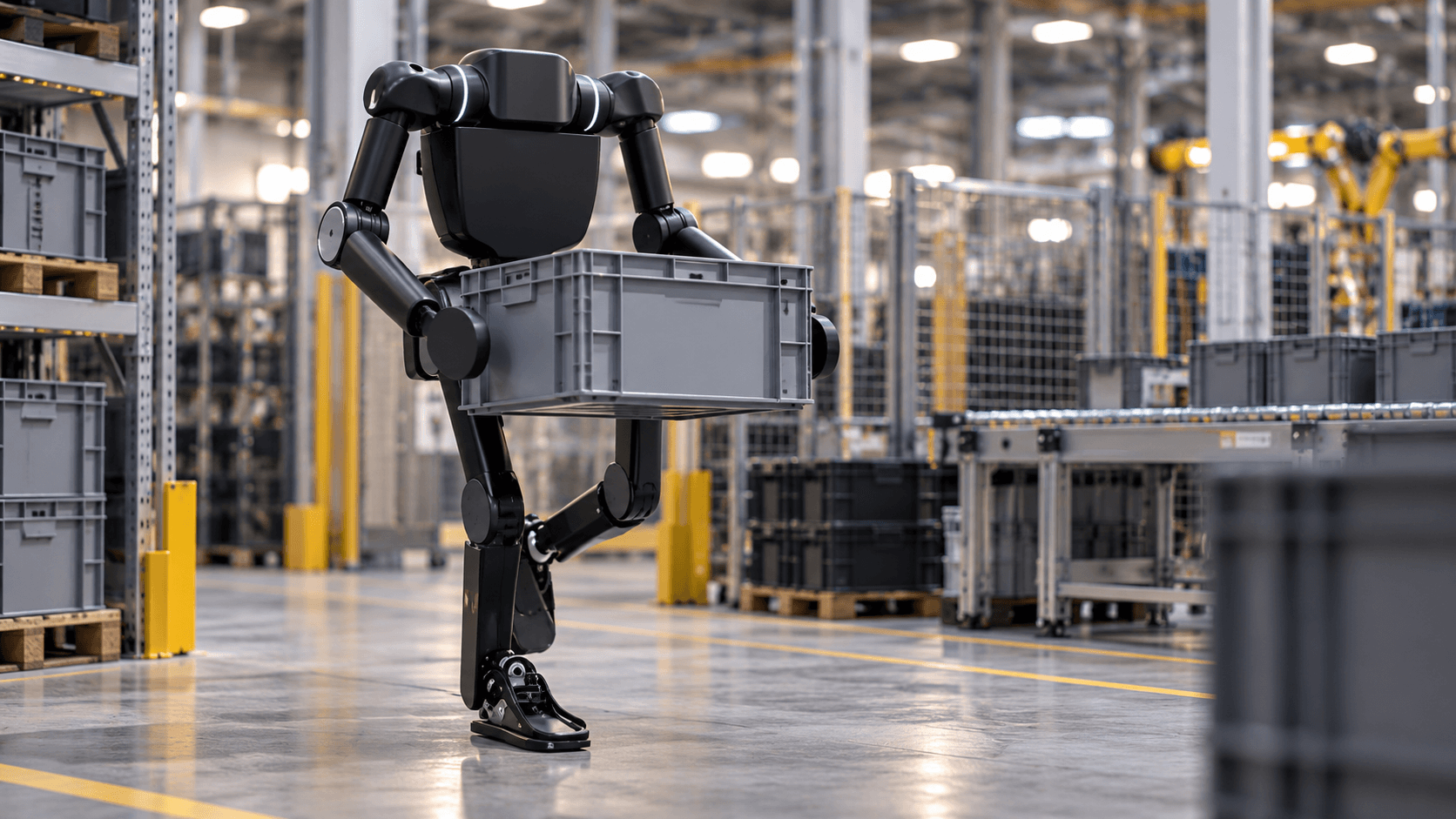
Calvin-40 is designed for physically demanding and difficult-to-staff jobs rather than entertainment or social interaction.
Wandercraft says the robot is being developed to handle objects including boxes, parcels, tires, panels and carts across factories and logistics environments.
The company is also working on additional capabilities such as picking and sorting, with construction and agriculture identified as potential future areas of use.
Instead of attempting to make Calvin-40 immediately capable of performing almost any human task, Wandercraft is taking a more focused approach.
Its strategy is to first make the robot reliable at defined groups of commercially useful tasks, deploy those capabilities in real environments and then use the resulting experience and data to gradually expand what the robot can do.
That approach reflects an increasingly important question for the humanoid robotics industry: whether general-purpose intelligence should come before large-scale deployment, or emerge progressively as robots accumulate more real-world experience.
From Medical Exoskeletons to Humanoid Robots
Wandercraft’s path into humanoid robotics is unusual.
Before developing Calvin-40, the company spent more than a decade building self-balancing robotic exoskeletons for people with mobility impairments.
Its Atalante X rehabilitation exoskeleton is now deployed in more than 150 rehabilitation centers worldwide, according to the company. Wandercraft says the balance, control and safety systems developed for medical robotics have provided part of the technical foundation for Calvin-40.
That experience could matter in industrial environments, where impressive motion alone is not enough.
Factories need machines capable of operating repeatedly around workers while maintaining predictable performance, uptime and safety.
Renault Is Already Putting Calvin to Work
One of Wandercraft’s most important industrial relationships is with Renault Group.
Renault took a minority stake in Wandercraft in 2025 and became an industrial partner as the two companies began developing a family of next-generation robots for manufacturing.
Calvin-40 is already operating on the production line at Renault’s Douai plant in France.
Renault’s roadmap calls for around 10 robots to be operating by the end of 2026, followed by approximately 350 robots across its French and Spanish factories by the end of 2027.
That gives Wandercraft something particularly valuable in humanoid robotics: a major industrial partner capable of providing both a real-world testing environment and a potential path toward larger fleet deployments.
The Next Test Is Deployment at Scale
Securing 12 customers is an important commercial milestone, but it is different from having 12 large robot fleets operating continuously.
Wandercraft has not disclosed how many Calvin-40 units each customer has ordered, which customers have progressed beyond trials, or how many robots are currently working in production environments.
Those numbers will become increasingly important as the humanoid industry moves from measuring progress through demonstrations toward measuring uptime, task completion, deployment size and economic value.
Still, the range of industries represented by Wandercraft’s new customers suggests that interest in industrial humanoids is expanding beyond automotive manufacturing alone.
Logistics, retail operations, healthcare facilities and defense logistics all involve repetitive physical tasks that are difficult to automate using fixed industrial machinery.
Humanoid and mobile robots are being developed specifically for those environments because they can potentially operate within infrastructure originally designed around people.
For Wandercraft, Calvin-40’s next phase will therefore be less about showing what the robot can do once and more about proving it can perform useful work safely and repeatedly.
The humanoid robotics race is increasingly becoming a deployment race—and customer adoption may ultimately matter much more than the most impressive demonstration.