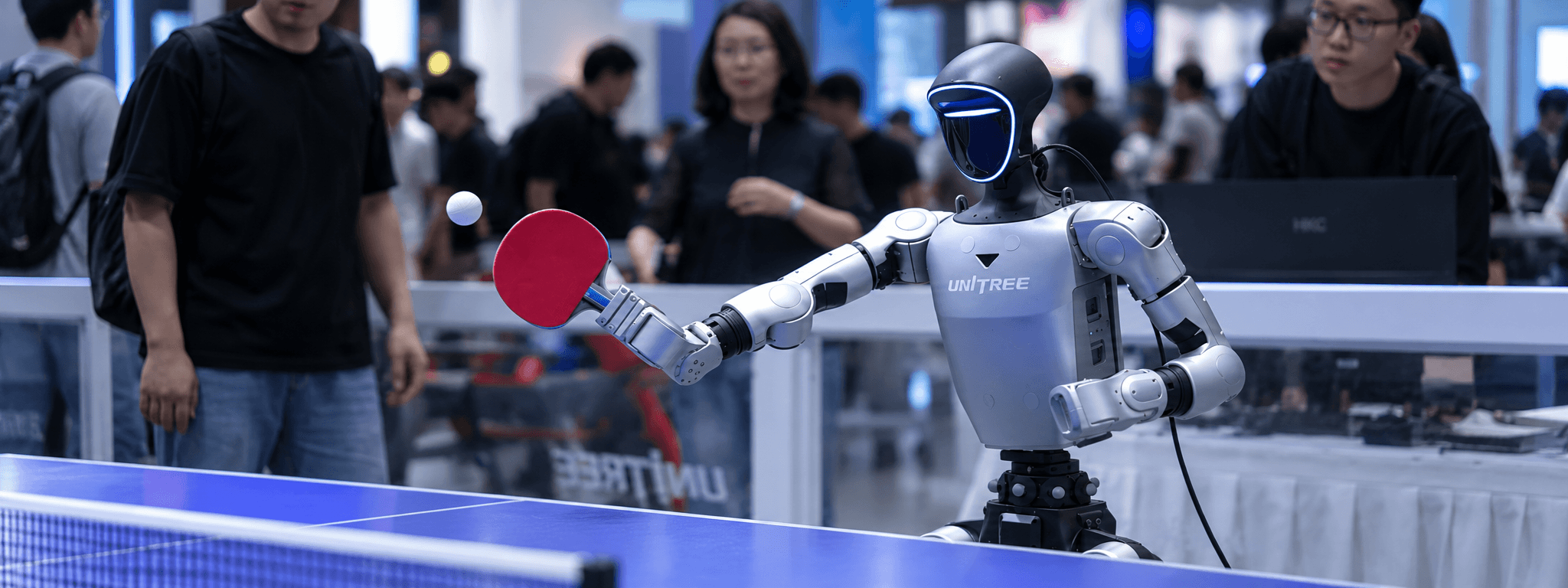

Unitree Robotics is developing an AI system designed to automate parts of the process of teaching humanoid robots new skills. Called Unitree Rehearsal, the project would allow AI agents to study research, generate robot-control code, test that code in simulation and evaluate the results on physical machines.
Founder and CEO Wang Xingxing outlined the initiative at the company’s World Physical AI Conference in Hangzhou on October 22, describing it as one of Unitree’s most important projects of the year. Rather than having engineers manually write and adjust every new behavior, the proposed system would use a repeating cycle of software generation, simulated trials, real-world testing and feedback.
The distinction matters in practice. Humanoid robots can already navigate environments and execute carefully prepared demonstrations, but reliable manipulation remains difficult when objects, surfaces or contact forces differ from training conditions. A control policy that works in simulation may fail on a real robot because of small errors in sensing, timing or movement. Unitree wants Rehearsal to shorten the cycle between identifying those failures and developing improved behavior.
Human researchers would not disappear from the process. Wang said people could still review outcomes and provide feedback, while AI systems handle more of the experimentation and code iteration. The longer-term ambition is to reduce the amount of manual engineering required each time a robot learns a new task.
Unitree is also developing what it calls Physical AI Robot Self-Evolution V1.0, an approach combining foundation models, multiple data sources, simulation and testing on actual robots. The company has not published independent performance results, detailed technical benchmarks or a commercial release date for Rehearsal. For now, it remains a research initiative rather than a demonstrated system that can reliably teach robots new skills without human intervention.
The project comes as Unitree expands its humanoid hardware lineup and pursues more capable AI models for physical tasks. Wang has said he hopes robots will eventually handle unfamiliar household instructions, such as tidying a room, with substantially less task-specific programming. Whether Rehearsal can deliver the necessary improvements will depend on results from real robots, not simulation alone.