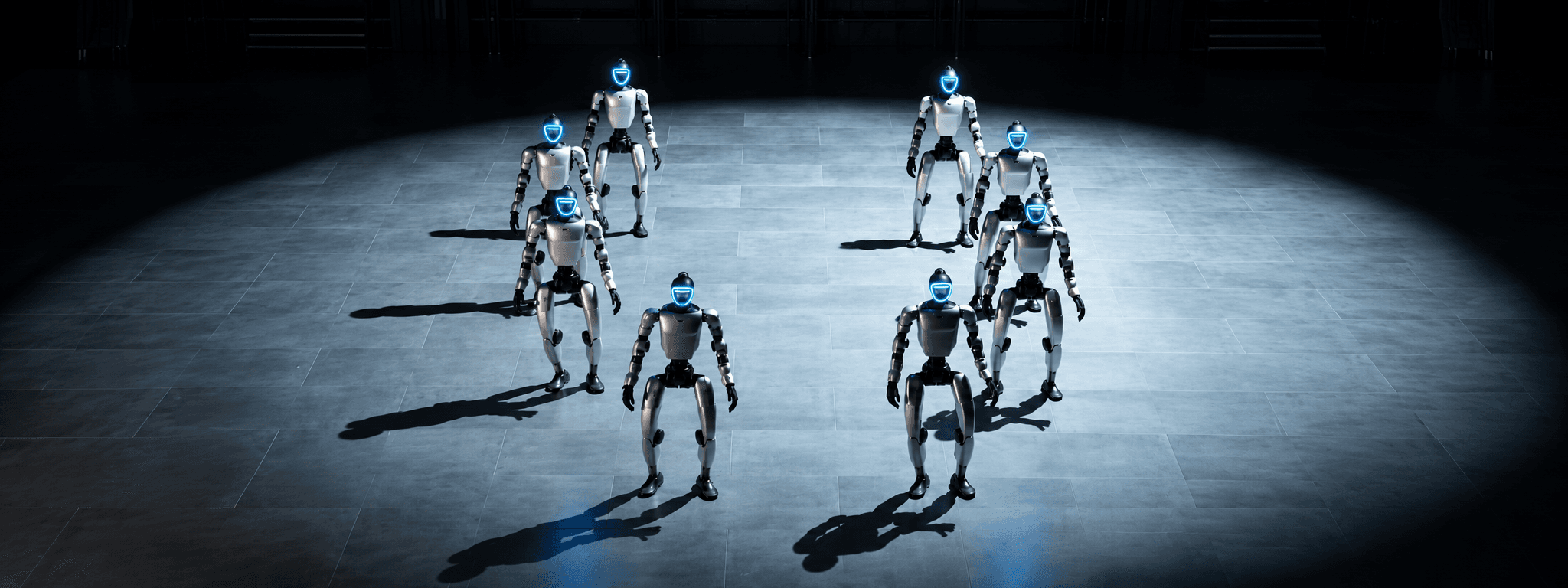

UniUni supports Unitree’s G1 and H2 humanoid robots and is available as a desktop application for Windows and macOS.
The platform combines 2D and 3D movement planning with a visual timeline that allows users to assign individual trajectories and action sequences to each robot. Operators can synchronize movements across a group without writing code.
An AI-assisted choreography function also allows users to describe desired movements and formations through natural-language instructions.
UniUni incorporates LiDAR-based mapping and localization to position robots within an environment. Users can import point-cloud maps, assign formations and check potential collisions before executing coordinated movements.
During operation, the software provides real-time monitoring of individual robots, including device connectivity, battery levels, temperature warnings and positioning information. Operators can also trigger emergency stops.
Unitree says the software has already supported coordinated humanoid performances at major public events, including China’s Spring Festival Gala and the Hong Kong Sevens rugby tournament.
The company is making UniUni available to Unitree users free of charge.
The initial release focuses primarily on synchronized performances and robot choreography rather than autonomous collaboration on industrial tasks.
Unitree has not disclosed the maximum number of robots that can be controlled simultaneously or published independent benchmarks covering positioning accuracy, communication latency or system reliability.
The release expands Unitree’s software ecosystem as the company continues developing humanoid hardware, robot foundation models and tools for customers operating multiple machines.