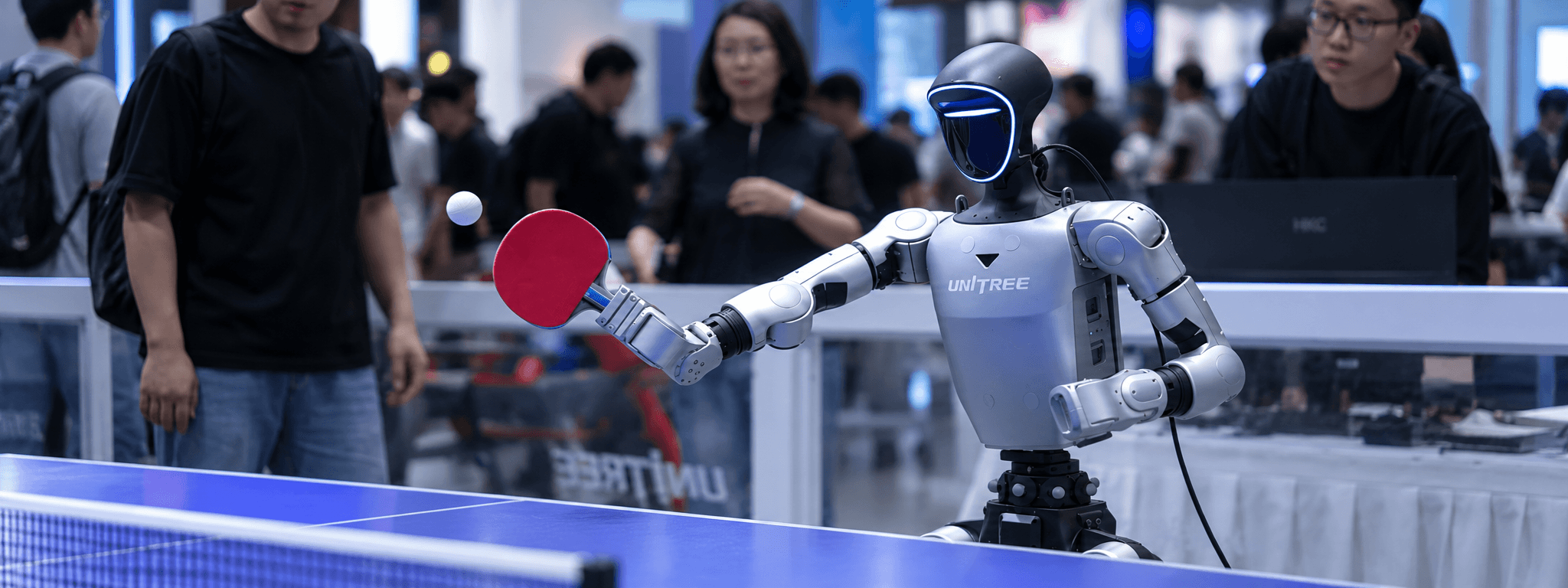
Unitree has released UnifoLM-WLA-1.0, a new open-source foundation model designed to control both stationary manipulation and whole-body mobile tasks using a single model.
The company announced the release on September 10, making the model available as part of its broader UnifoLM embodied AI stack. Unitree says the system supports cross-task and cross-end-effector generalization, allowing learned behavior to transfer across different tasks and robot grippers or hands rather than requiring a separate policy for every configuration.
UnifoLM-WLA-1.0 combines the company’s UnifoLM-ER-Flow multimodal backbone with an MMDiT-based action expert. According to Unitree, training used approximately 2,500 hours of high-quality real-robot data spanning multiple robot embodiments and operating environments.
The company says the model was evaluated on 64 real-world tasks, including tabletop manipulation and whole-body mobile manipulation. Unitree also claims the model achieved state-of-the-art results across several embodied reasoning benchmarks among open-source systems and approached the performance of leading closed models. Those benchmark comparisons are company-reported and have not yet been independently validated.
Unitree is developing its UnifoLM software stack alongside its humanoid hardware, including the G1. WLA-1.0 adds a unified model for stationary manipulation and whole-body mobile tasks.
Earlier UnifoLM work separated world modeling, robot action and teleoperation datasets into different components. WLA-1.0 moves toward a more unified control architecture where one model can coordinate perception, manipulation and locomotion.
Unitree is now pushing an open software layer developers can build on across humanoid tasks, potentially widening access to whole-body robot learning alongside its G1 and other hardware platforms.