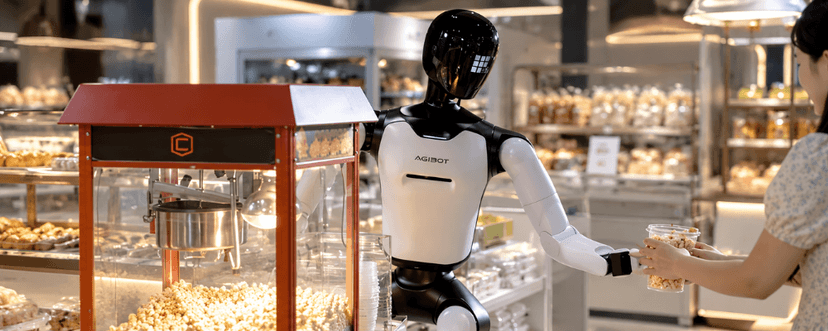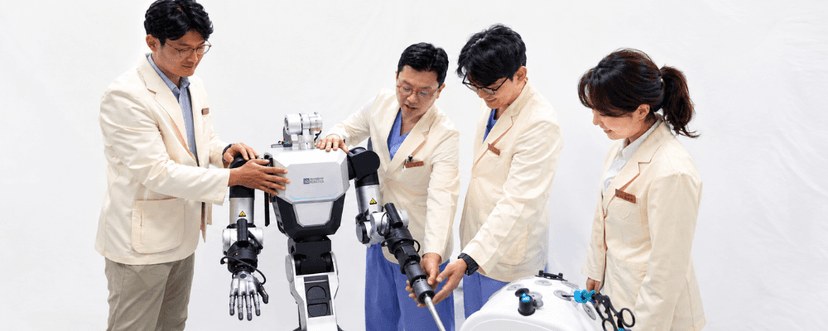

The robotics industry often gets discussed as a hardware race. Which humanoid has the best hands? Which one walks fastest? Which manufacturer can produce robots at the lowest cost?
Those questions matter, but they may not determine the industry’s eventual winners.
As physical AI develops, robotics is increasingly becoming a data business.
Robots Have an AI Data Problem
Large language models benefited from an enormous resource: the internet. Text, images, videos and code already existed at massive scale before today’s AI boom.
Robotics doesn’t have the same luxury.
A robot needs to understand weight, friction, balance, force, object position and what happens when the physical environment changes unexpectedly. Simulation can generate enormous amounts of training experience, but Deloitte notes that a persistent gap remains between simulated environments and the nuances of the real world.
That means useful physical AI requires something expensive: real-world experience.
A humanoid may need thousands of demonstrations of picking, placing, sorting, opening, carrying and manipulating objects before it can perform reliably across changing environments.
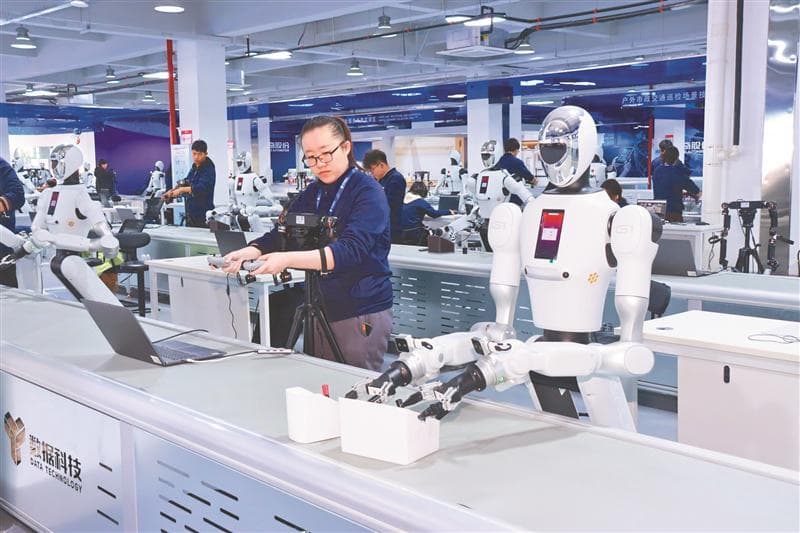
This is why robot training facilities are beginning to look surprisingly similar to AI data centers—except instead of racks of GPUs, they contain robots, operators and recreated workplaces.
Robot Data Factories Are Emerging
The scale of this effort is already increasing.
Apptronik launched a robot training facility with Google DeepMind in June specifically to collect large-scale real-world data and help move humanoids from pilot programs toward production deployments.
China is building similar infrastructure. Industry reporting this month indicates that embodied-AI developers are rapidly expanding data collection, although robot makers say high-quality data remains scarce. Controlled training centers cannot perfectly reproduce the unpredictability of actual factories, warehouses and commercial environments.
That distinction is important.
One million hours of mediocre robot demonstrations aren’t necessarily more valuable than 100,000 hours covering diverse environments, failures and difficult edge cases.
The robotics industry may eventually care less about how much data a company owns and more about how useful that data is for improving autonomy.
Every Deployed Robot Could Become a Data Collector
This creates an interesting potential business flywheel.
Imagine a robotics company deploying 1,000 machines into factories.
Those robots encounter different boxes, tools, lighting conditions, floor surfaces, workers and unexpected situations. With appropriate permissions, security controls and data governance, relevant operational experience can feed back into training systems.
The models improve.
Improved models make the robots more useful.
Better robots attract additional customers.
More deployments potentially generate more diverse experience.
That cycle could become one of the strongest competitive advantages in physical AI.
It’s similar to the logic behind autonomous-driving fleets: deployment isn’t only commercialization—it can also contribute to the learning infrastructure.
Hardware Could Become Less Differentiated
Another change is happening at the same time.
Humanoid developers increasingly have access to outside suppliers for motors, actuators, sensors, batteries, processors and even complete robotic subsystems.
Recent industry analysis found that humanoid manufacturers are increasingly sourcing mature hardware while concentrating internal resources on software and applications. One estimate expects collaborative-robot hardware shipments to humanoid manufacturers to rise from about 5,000 units in 2025 to more than 43,000 in 2026.
That could gradually change where value sits.
If several companies can purchase comparable actuators, sensors and compute hardware, simply assembling an impressive humanoid becomes less defensible.
What becomes harder to replicate is the accumulated intelligence created through millions of physical interactions.
The Market May Develop a New Robotics Supply Chain
This also opens an industry beyond robot manufacturers themselves.
Companies could specialize in collecting demonstrations, operating robot-training facilities, generating synthetic environments, annotating physical interactions, providing teleoperation networks or creating marketplaces for robotics datasets.
There are already early signs of such an ecosystem. Specialist providers, open datasets and proprietary data engines are emerging around physical AI, although a standardized commodity market for robotics data has not yet formed.
The opportunity could therefore extend far beyond companies selling humanoids.
Just as the AI boom created demand for GPUs, cloud infrastructure and data services, physical AI could create its own infrastructure layer around robot data collection, simulation, training, evaluation and fleet learning.
Opinion: Don’t Just Count Robots. Count What They’re Learning.
Humanoid shipments are growing quickly. Counterpoint Research reported that global shipments increased nearly 300% year over year during the first half of 2026.
But shipment numbers alone won’t tell us which companies are building durable advantages.
A more interesting question may be:
What happens after the robot is delivered?
If it performs the same programmed routine indefinitely, it is essentially another automation machine.
If every deployment helps a company’s models become more capable across thousands of machines, the economics become very different.
The robotics industry is still obsessed with who can build the most impressive body.
The longer-term competition may be about who builds the smartest learning loop.