
Announced on October 14, the model uses a Perception-Language-Action (PLA) architecture that integrates 3D vision, tactile sensing, force feedback, audio, robot state and language.
The system is designed to help robots understand physical interactions that cannot be interpreted through cameras alone.
For example, tactile feedback can help determine whether an object has been securely grasped, while sound can indicate whether a mechanical component has been correctly engaged.
Neuron AI also incorporates memory, allowing robots to retain information about objects and previous actions when those objects are no longer visible.
According to NEURA, the model has been developed to operate across five different robotic embodiments, including systems equipped with different hands and grippers.
Its training combines real-world robot data collected through NEURA Gyms, simulated environments and human demonstrations captured using sensor-equipped suits.
The company is integrating the model into Neuraverse, its robotics platform that allows customers to develop, fine-tune and distribute robotic skills across connected machines.
NEURA plans to demonstrate the technology at NVIDIA GTC Berlin, taking place from October 20 to 22.
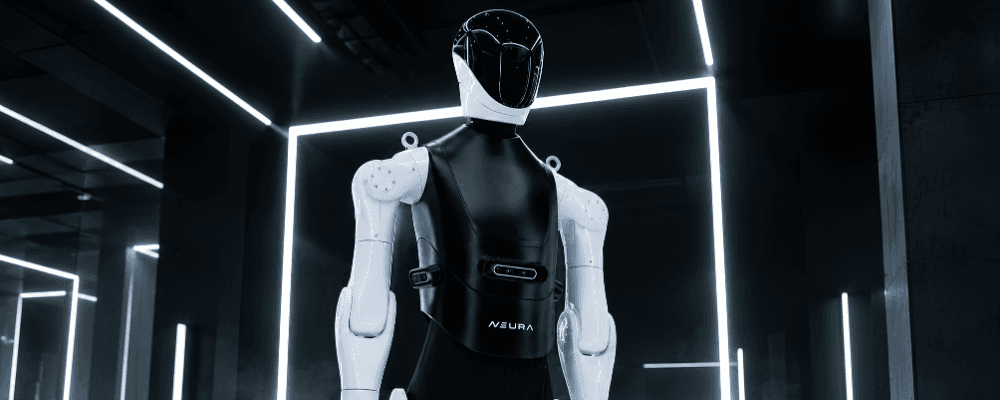
During the event, its 4NE1 humanoid will perform an eleven-minute autonomous laundry sequence involving sorting clothes, loading a washing machine, closing and reopening the machine, unloading the laundry and transferring it to a dryer.
The company says the sequence will be completed without human intervention.
The demonstration is intended to show how the model coordinates multiple physical actions while maintaining information about the task and its surrounding environment.
Neuron AI was developed and trained at NEURA’s headquarters in Metzingen, Germany.
The company is also working with industrial partners, including Bosch and Schaeffler, to collect data and develop robotic capabilities for manufacturing environments.