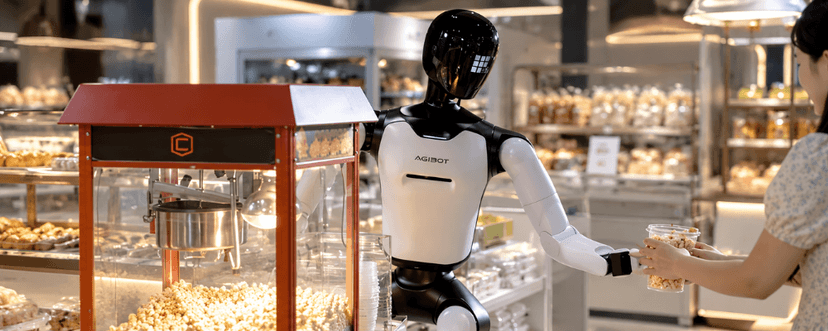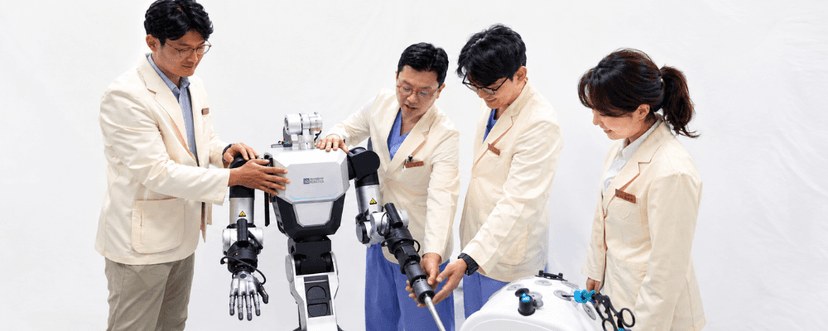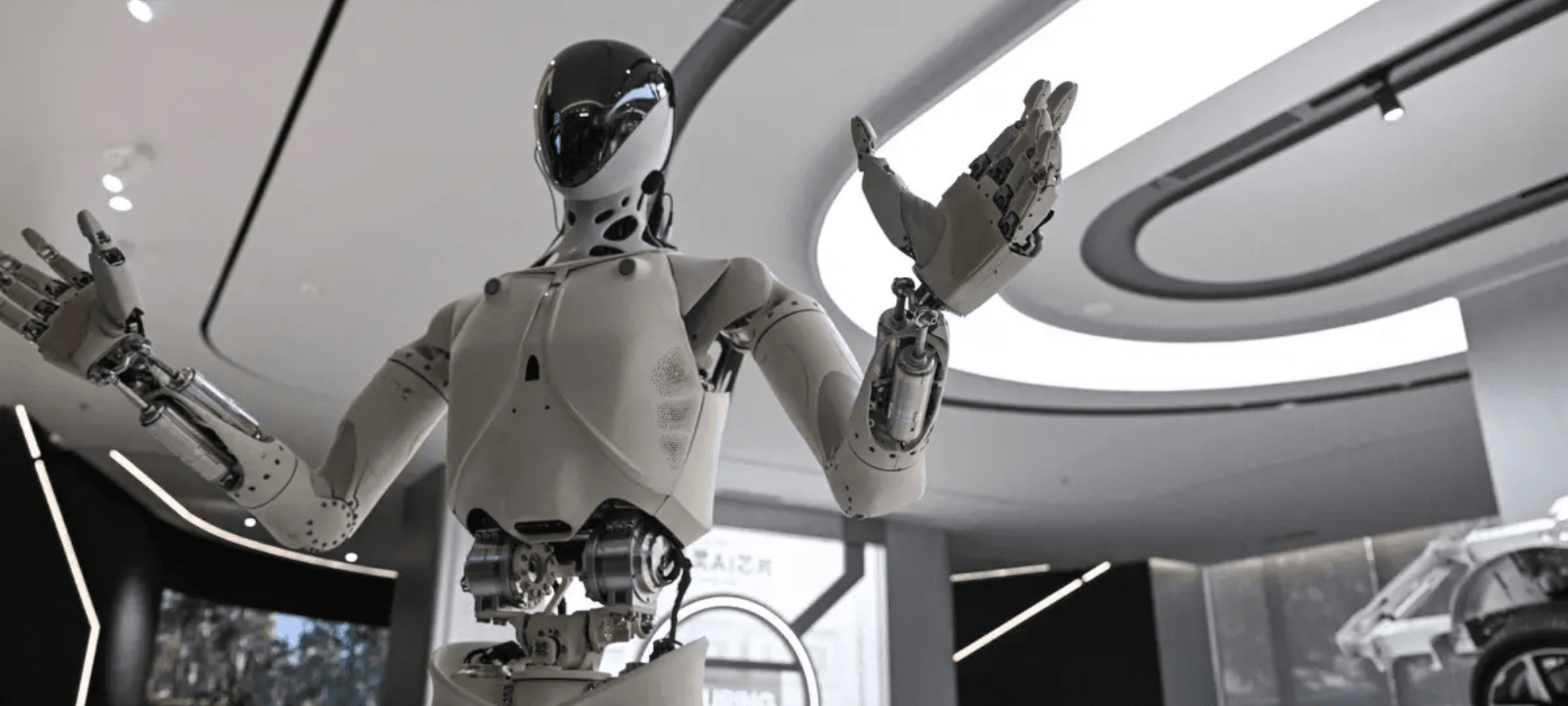

For forty years enterprises have wired software into every corner of their operations. ERP systems schedule production. TMS platforms route shipments. Machine learning models forecast demand and detect anomalies. Yet when something physical must actually move or change in the world, the instruction still lands on a human body. Humanoid robots are poised to close that gap. They act as a general-purpose execution layer that lets software operate directly in warehouses, factories, hospitals and construction sites.
From digital instructions to physical actions
Traditional automation has always been constrained by form factor. A conveyor or a robotic arm can execute a narrow task with extraordinary precision, but only inside a tightly engineered envelope. Outside that envelope, workflows revert to clipboards, radio calls and human improvisation.
Humanoid robots change this relationship between code and the physical world. They can stand where a person stands, reach what a person reaches and manipulate the same tools and interfaces that people use. A warehouse management system that already decides which pallet should move where can, in principle, route that task not to a human picker, but to an embodied agent that logs in, scans items, pushes carts and seals cartons. The decision stays in software. The execution no longer depends on human muscles.
In this framing, the humanoid is not the star of the show. It is an endpoint. It is the equivalent of a server in a data center, but for physical tasks rather than computations. What matters is how cleanly it can accept instructions, report state and handle the long tail of exceptions that make the real world messy.
The physical economy is not API‑native yet
Digital systems already provide rich APIs for information. Finance, advertising, cloud computing and software distribution all run on machine‑to‑machine protocols. The physical economy does not. It still relies on fragmented interfaces that require human interpretation at every hand‑off. A planner exports a schedule from an application, a supervisor reads it, a team leader assigns people, and only then does the plan materialise in motion.
Humanoid robots create the possibility of an API surface for physical work itself. A task can be described in software, decomposed into steps, and sent to a fleet of embodied agents that understand doors, stairs, ladders, pallets, valves, carts and cables because they have been trained in environments built for humans. The vocabulary of those tasks does not need to be reinvented. It mirrors existing work instructions.
This is where humanoids differ from earlier waves of automation. Instead of asking operators to rebuild their facilities around fixed machines, they offer a way to turn installed infrastructure into something programmable. Shelves, tools, control panels and vehicles become addressable resources because there is finally an agent in the loop that can handle them as a person would.
Physical AI turns spaces into programmable substrates
Recent advances in physical AI, particularly multimodal vision‑language‑action models, allow robots to perceive their environment, understand instructions and map them to appropriate behaviours in real time. These systems learn from a mix of simulation, real‑world sensor data and human demonstrations to build internal models of how objects behave, how forces propagate and how to recover from disturbances.
When such a model is paired with a humanoid body, the result is not just an agile machine. It is a software‑defined agent that can be retargeted across tasks and even across sites. A warehouse slotting change, a new inspection routine or a revised safety protocol can be rolled out as an over‑the‑air update instead of a mechanical retrofit. In effect, space becomes programmable. The same square metre of floor can host many different workflows over its lifetime because the intelligence lives in software rather than in fixed hardware.
Consultants and research groups now describe this convergence as the formation of a “physical AI stack” where sensing, simulation, world models and execution are tightly integrated. Humanoids sit at the bottom of that stack. They are the actuated layer that turns model outputs into motion. Without an embodiment capable of navigating stairs, thresholds, irregular surfaces and human‑scale interfaces, the stack cannot fully reach the real world.
Does the humanoid form matter?
If humanoids are “just” endpoints, it is natural to ask whether their specific shape really matters. Could other robots not fulfil the same role. In some cases they can. Drones and mobile bases already serve as excellent endpoints for inspection and material transport. Yet they run into hard limits in environments tuned to human constraints.
Market analyses suggest that more than eighty percent of warehouses still operate with minimal fixed automation, and that most are constrained by layouts, ceilings and access paths that match human bodies, not robots. Humanoid form factors are attractive in that context because they can traverse the same aisles, mount the same stairs and reach the same pick faces as the workers they augment.
The constraint is not simply movement. It is interaction. Control panels, emergency stops, hand tools, pallets, doors and vehicles all assume a certain configuration of limbs, grips and reach. Matching that configuration with a humanoid embodiment reduces the need for custom fixtures or interface redesign. For operators, this is the difference between upgrading software and rebuilding a property.
Labour shortages create a pull, not just a push
Software‑driven execution would be interesting even in balanced labour markets. In today’s conditions it becomes urgent. Logistics, manufacturing and industrial operations continue to report persistent difficulties in hiring and retaining frontline workers, with surveys showing that close to sixty percent of manufacturers cite talent shortages as their top operational challenge. Analysts project that millions of industrial jobs could remain unfilled over the coming decade if current trends persist.
In this environment humanoid robots are less a threat to employment and more a release valve. They absorb work that would otherwise be dropped, deferred or shifted to already strained teams. Crucially, they do so while speaking the same “language” as existing software systems. A scheduling engine can allocate tasks to a mixed pool of humans and robots. A warehouse control system can choose whether a specific move is executed by a person, a traditional robot or a humanoid, depending on availability and economics.
The more accessible that orchestration becomes, the more humanoids resemble a capacity resource rather than a bespoke project. They turn labour shortages into a problem that can be addressed by scaling an endpoint fleet rather than by rewriting the surrounding process.
From pilots to heterogeneous fleets
Evidence from early deployments suggests that humanoids will not operate in isolation. They will join heterogeneous fleets that mix automated guided vehicles, autonomous mobile robots, fixed arms and inspection drones. In such fleets, humanoids usually take the last, messy twenty percent of tasks that involve climbing, reaching, opening, unplugging, clearing or improvising around unexpected obstacles.
Industry reports describe 2026 as a turning point in this direction, with a growing number of commercial humanoid platforms available for structured lease and an increasing emphasis on orchestration software that can dispatch work across different agent types. The humanoid’s role in these systems is to extend the reach of software into corners of the workflow where specialised machines are uneconomical or too rigid.
Humanoids are not arriving to replace everything. They are arriving to complete the interface between code and the physical world.