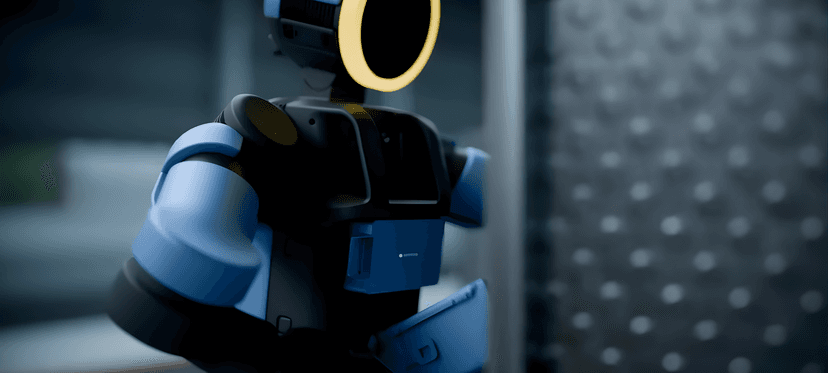

A two year old startup in Irvine, California just entered the unicorn club without ever shipping a single robot.
Field AI does not sell hardware. It does not build robotic arms, tune actuators, or manufacture anything at all.
What it sells is something far less visible and, if they are right, far more valuable.
The brain.
The software layer that sits on top of someone else’s hardware and decides where it goes, what it avoids, how it moves, and whether the next step is worth taking.
In robotics, everyone talks about the body.
FieldAI is betting the real value sits in the mind.
From JPL to the Jobsite
FieldAI was founded in 2023 by Dr. Ali Agha, a roboticist whose background reads like an autonomy masterclass.
Before starting the company, Agha spent seven years at NASA Jet Propulsion Laboratory as a Technologist and Group Leader. He led Team CoSTAR, a group made up of JPL, MIT, Caltech, KAIST, and LTU that won the Urban Phase of the DARPA Subterranean Challenge in 2020 and placed second in the Tunnel Phase.
CoSTAR stands for Collaborative SubTerranean Autonomous Resilient Robots, and the NeBula autonomy stack it produced became one of the best examples of how machines handle unmapped, unstable, GPS denied environments.
At JPL, Agha also led DARPA RACER, the off road high speed autonomy program, and worked on coordinated autonomy between the Mars Helicopter and Rover. Before JPL, he worked at Qualcomm Research, completed postdoctoral work at MIT, and earned his PhD in Computer Science and Engineering from Texas A&M.
That background matters.
A lot of robot brain startups today are coming from language model labs. Most are attacking the problem from the top down. Take an internet trained vision language model and teach it to output motor commands.
FieldAI is doing the opposite.
It is working from the bottom up. Take years of tunnels, dust, fog, mud, and near failures, then turn that into a model that knows what it does not know.
One Brain, Every Body
The pitch is simple.
One model, every embodiment.
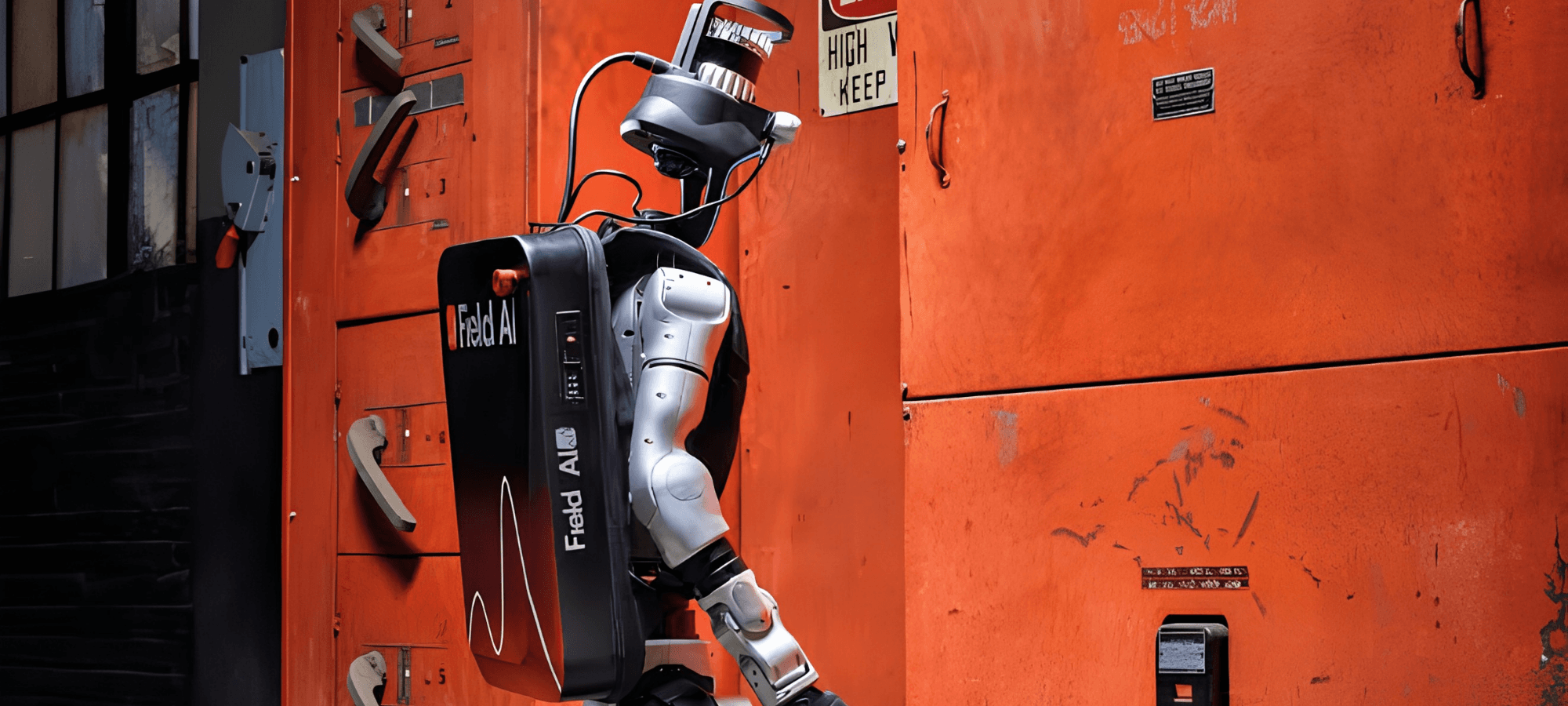
FieldAI’s Field Foundation Models, or FFMs, already run on quadrupeds, humanoids, wheeled robots, and even passenger scale vehicles.
No hardware specific fine tuning.
No pre mapped environments.
No GPS.
The same core intelligence that guides a quadruped through a construction site in Santa Clara can also guide a humanoid through a warehouse in Osaka.
Under the hood, the system breaks into three parts.
The Dynamics Foundation Model handles movement itself. Slips, stumbles, recovery, balance, unstable terrain.
The Multi Agent Foundation Model handles fleets of robots working together in the same space.
Then there is the Safety and Risk Awareness layer, which turns every decision into a probability weighted calculation instead of a confident guess.
That last part matters most.
In robotics, almost right is still failure.
Inference runs entirely on the edge with sub 100 millisecond latency.
No cloud dependency.
No connectivity requirement.
No excuses.
FieldAI has stayed deliberately fabless.
While Figure AI, 1X Technologies, and Agility Robotics build both the robot and the software, and while Boston Dynamics still owns every layer of its stack, FieldAI is positioning itself as infrastructure.
Closer to Android than Apple.
The bet is simple.
Hardware becomes cheaper.
The brain captures the margin.
Proven on Real Jobsites
This is not just a theory.
The deployments are already happening.
In November 2025, FieldAI published a case study with DPR Construction showing what the system does at scale.
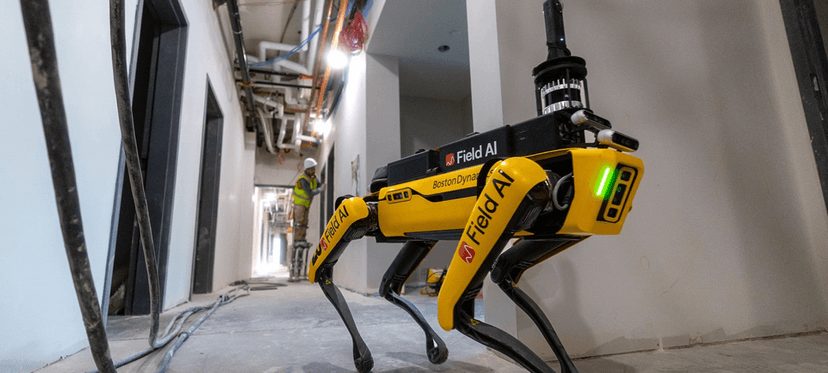
On an active construction site in Santa Clara, a Boston Dynamics Spot running the FieldAI Brain autonomously collected more than 45,000 photos, walked over 100 miles, mapped four floors, documented 125,000 square feet of roofing, and scanned 500,000 square feet of interiors.
No map.
No planned route.
No human standing nearby with a joystick.
Just autonomous execution.
DPR superintendent Justin Schreiner said the system had been on site for roughly eighteen months, mainly handling construction progress tracking through photography, hazard detection, material movement monitoring, and overnight security scans.
That is when autonomy stops being a demo and starts becoming infrastructure.
Beyond construction, FieldAI says it has active deployments across energy, manufacturing, urban delivery, and inspection across Japan, Europe, and the United States, even though most customer names remain private.
That matters because those are some of the most regulated and safety sensitive industries in the world.
If you can win there, you can win almost anywhere.
The IP and the Headcount
FieldAI is starting to lock this technology down with patents.
Its first public filing, U.S. Patent Application 2025/0252306, focuses on terrain analysis.
Instead of treating terrain like a yes or no decision, the system predicts slope, roughness, and step height as probability distributions.
The robot does not think “I can step here.”
It thinks “there is a very high chance I can step here safely, a small chance I slip, and a very small chance the surface is worse than it looks.”
That is a very different way to think about autonomy.
The company has also been hiring aggressively.
More than 100 employees joined leading up to the August 2025 raise, and the stated plan was to double headcount again by year end.
Most of that hiring leans toward locomotion and manipulation, which tells you where they think the next frontier is.
Not just navigation.
Dexterous work.
Real physical labor.
The Stakes
If FieldAI is right, robotics splits into two categories.
On one side, hardware manufacturers race to commoditize chassis, actuators, and battery systems.
On the other, a small number of brain providers capture the software margin.
That second category is where the real power sits.
It is the Microsoft model.
It is the Android model.
And it may become the robotics model.
FieldAI raised $405 million in 2025 from investors including NVIDIA, Intel Capital, Khosla Ventures, Samsung, Temasek, and Bezos Expeditions.
That buys runway.
But more importantly, it buys time to prove whether this layer thesis is actually right.
Competitors like Skild AI and Physical Intelligence have bigger valuations.
But FieldAI has something harder to copy.
A decade of DARPA and NASA data on what happens when robots fail in the real world.
And in robotics, failure data is often more valuable than success.
Because failure is where autonomy gets built.
No maps.
No GPS.
No hardware.
Just one brain, everywhere.