

Boston Dynamics has always been the hardware benchmark. Spot’s gait is clinic-level. Atlas’s acrobatics still draw millions of views. Stretch’s logistics muscle quietly powers warehouses most people never see. For twenty years, the company’s answer to “who writes the software that runs on this robot?” was a single word: we do. Which makes the March 12, 2026 partnership with FieldAI read as something quieter and more strategically significant than a normal press release. One of the most vertically integrated companies in robotics just plugged in a third-party brain.
What was announced
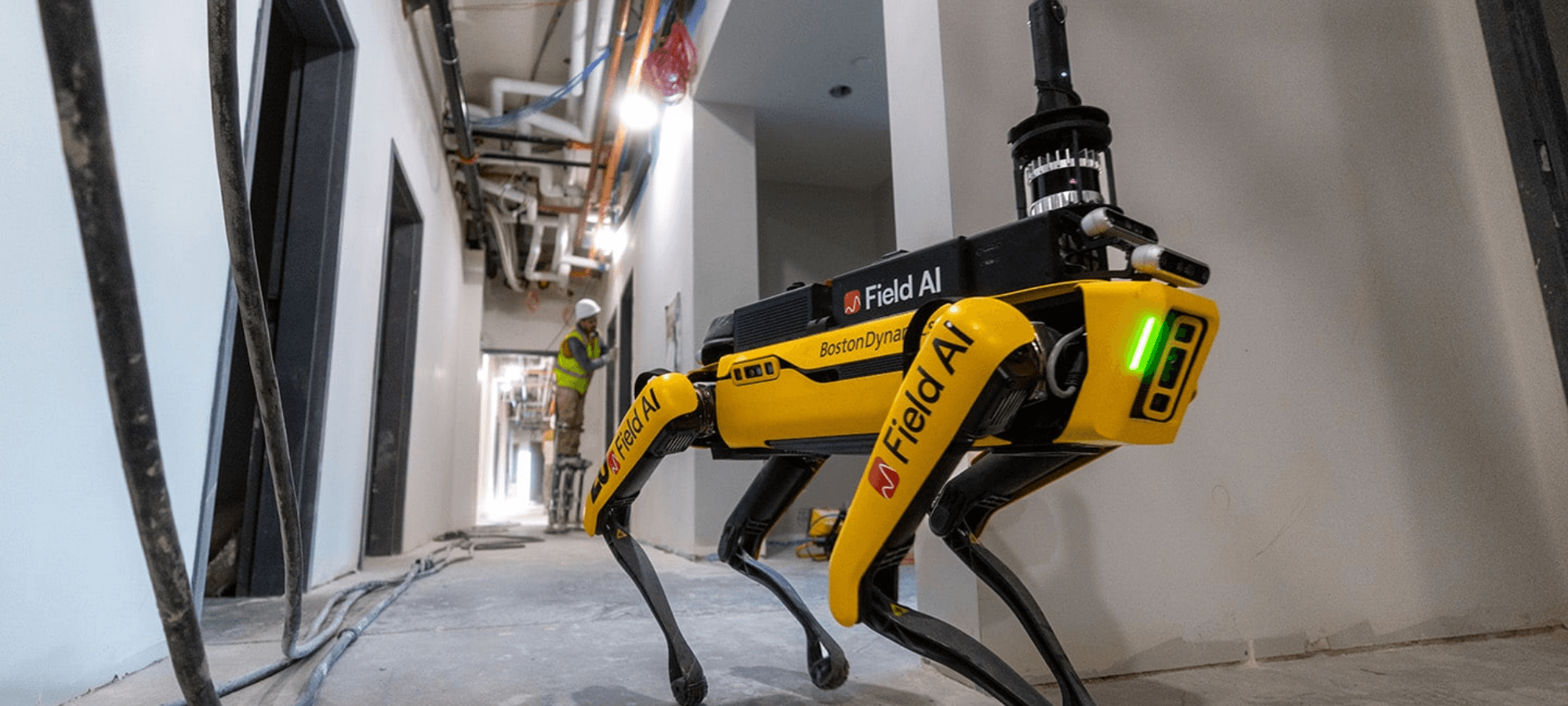
Boston Dynamics will integrate FieldAI’s Field Foundation Models into its platforms, starting with Spot for construction and industrial inspection. Stretch and the electric Atlas are referenced in the announcement as future targets. The initial rollout focuses on dynamic, uncharted environments where Spot’s traditional autonomy stack, strong at pre-mapped patrols, has historically required human operators to fill in the blanks.
FieldAI supplies what Spot was missing: a risk-aware decision layer that operates without maps, without GPS, without pre-mapped layouts. The stack handles multi-robot fleet coordination, runs on-device with sub-100ms latency, and requires no cloud dependency. In practice, this means a customer can drop a Spot onto an active construction site it has never seen, give it a high-level goal, and walk away.
The quotes that matter
Marc Raibert, Boston Dynamics founder and executive director of the Boston Dynamics AI Institute, framed the deal in terms of capability gaps: “Combining Field AI’s expertise in risk-aware autonomy with Spot’s remarkable mobility allows us to tackle uncharted and highly dynamic environments.” The subtext is revealing. Raibert, who spent three decades building the world’s best-moving robots, is publicly acknowledging that the intelligence layer is now a distinct discipline, and one worth partnering out.
Ali Agha, FieldAI’s CEO, kept the framing on decision quality: “The real breakthrough is developing robots that understand risk and make decisions in real time.”
The DPR proof point
The partnership did not come out of nowhere. For roughly eighteen months before the announcement, DPR Construction had been running Spots powered by the FieldAI Brain on active jobsites in Santa Clara, California. The case study, published in November 2025, quantified the deployment at an operational scale that matters.
On one jobsite, the robot autonomously collected more than 45,000 photos, walked over 100 miles, mapped four floors, documented 125,000 square feet of roofing, and scanned 500,000 square feet of interiors. It monitored material movement, performed hazard detection, and ran overnight security patrols. DPR superintendent Justin Schreiner, in the accompanying video, described the primary use as tracking construction progress through photography, work that traditionally requires a human walking the site with a camera and a clipboard.
The deployment also reported efficiency gains on the order of 90%+ for inspection time, with early hazard detection reducing the kind of costly rework that eats construction margins.
What Spot used to need, and doesn’t anymore
Spot has always been capable of autonomous missions, but the traditional workflow was pre-mapping heavy. Operators would walk the site, set waypoints, define inspection tasks, and re-verify after any layout change. On a construction site, where the layout changes daily, sometimes hourly, that workflow limited deployment to the stable, repetitive corners of a facility. FieldAI’s stack removes the pre-mapping requirement entirely. Spot figures out the site as it moves through it, treats unknown terrain probabilistically, and adjusts in real time.
The same logic extends to environments Boston Dynamics has historically struggled to serve: mines, tunnels, disaster zones, offshore energy infrastructure, and any site where mapping is either impossible or obsolete by the time it finishes.
What it signals for Boston Dynamics
Boston Dynamics building on top of a third-party brain is the story. For twenty years the company has owned every layer of its stack, hardware, dynamics control, autonomy, operator tooling. The shift suggests two things.
First, the generalist-autonomy problem is moving faster than any single vertical integrator can keep up, even one with the best legs in the business. FieldAI, Physical Intelligence, and Skild AI have collectively raised close to $2.5 billion in the past eighteen months, and their pace of model iteration now outstrips what any in-house robotics team can match on its own.
Second, Hyundai, which acquired Boston Dynamics in 2021 and has been quietly steering its long-term roadmap, appears to be pulling the company toward a different value-capture model. Less “sell the full stack at a premium,” more “sell best-in-class hardware and let the market’s best intelligence ride on top.” That is a meaningful cultural shift for Boston Dynamics, and it has implications for how Atlas will ship. Read alongside the electric Atlas roadmap, the partnership hints at a future where Atlas itself may run an autonomy stack Boston Dynamics didn’t write.
What it signals for the brain layer
For FieldAI, the partnership is a distribution breakthrough. Landing the most iconic robotics brand in the world as a platform partner validates the layer hypothesis: that a single brain vendor can sit above every hardware maker. For Physical Intelligence and Skild AI, it is a shot across the bow. The next customer conversations at Figure, 1X, Agility, Unitree, Sanctuary, and every other humanoid-hardware startup will start with the same question: why write this ourselves?
The competitive read
Spot has competitors. ANYbotics has more than 200 legged robots deployed, primarily in energy and mining, and has raised over $130 million. Unitree’s industrial quadrupeds are beginning to appear in inspection contracts at aggressive pricing. If FieldAI’s stack becomes available on Spot and not on its rivals, Boston Dynamics suddenly has a software moat on top of its mobility advantage. If the stack becomes available on everyone, the hardware race compresses into a margin fight, exactly the bifurcation FieldAI’s thesis predicts.
Either outcome is a win for FieldAI. The only question is which one Boston Dynamics negotiated for.