
The future of home robotics is often presented as a race to build better hardware, more capable humanoid bodies, and more advanced artificial intelligence. That framing is understandable, but it does not fully explain why the category has remained slower to mature than many observers expected.
The more important constraint is data.
A domestic robot does not merely need to recognize a room, move through it, and manipulate objects. It needs to act with competence inside an environment that is permanently changing. It must understand the difference between a glass that should be placed in a cabinet, a glass that should remain on a bedside table, and a glass that has been left dangerously close to the edge of a counter. It must interpret intent, physical context, object state, human preference, and safety risk in real time.
That kind of intelligence cannot be created through hardware alone. It depends on embodied experience, which means data gathered from robots interacting with the physical world. Physical Intelligence describes this distinction directly in its work on π0, explaining that robot foundation models require data across images, text, and actions rather than language or images alone.
This is why the data problem has become one of the central challenges in home robotics. The challenge is not whether a robot can complete a task once in a demonstration. It is whether it can perform that task again and again across thousands of homes, with different layouts, objects, lighting conditions, habits, and edge cases.
Why home robotics is harder than industrial automation
Industrial robotics became commercially successful because factories were designed around the machine. The environment was simplified, standardized, and controlled. Objects arrived in known positions. Tasks were repeated with minimal variation. The surrounding world was engineered to reduce uncertainty.
The home is the opposite.
Every domestic environment is a living system. A kitchen changes after breakfast. A living room changes when a child has been playing. A bedroom changes with clothing, laundry, pets, lighting, clutter, and personal habit. Even when two homes contain the same objects, they are rarely arranged in the same way.
This is why traditional robotics struggles in domestic settings. A pre-programmed robot can succeed when the world behaves as expected. A home robot must succeed when the world refuses to behave as expected.
The technical problem is not only movement. It is interpretation. A domestic robot must decide what matters in a scene, what can be ignored, what should be moved, what should not be touched, and what action is appropriate under the circumstances.
That type of judgment requires exposure to enormous variation.
Home robots need embodied AI
Programmed behavior to learned behavior is one of the most important changes in robotics.
In the older model, engineers attempted to define specific instructions for specific tasks. That approach works when the task is narrow and the environment is predictable. It breaks down when the robot must generalize.
Modern robotics is moving toward embodied AI, where robots learn from demonstrations, physical interaction, simulation, and multimodal models. Instead of being told every possible step in advance, the robot learns patterns of action from experience.
This is significant because it changes the nature of the machine. A robot is no longer only executing a command. It is selecting an action based on prior exposure to similar situations.
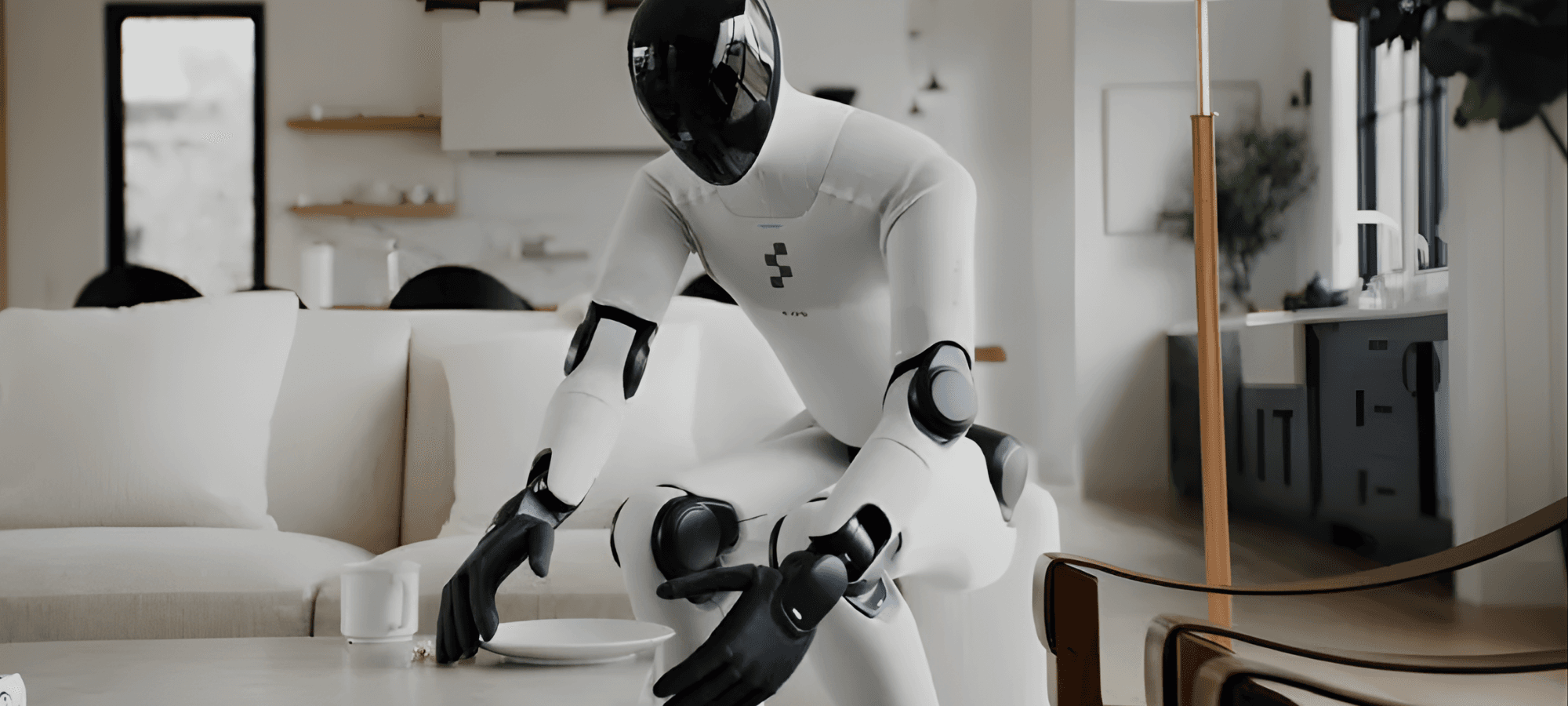
The promise is powerful. A capable domestic robot could eventually learn to fold clothes, clear a table, organize shelves, load a dishwasher, assist an older person, or prepare a room without requiring a custom program for each home.
The dependency is equally clear. A robot can only generalize from what it has learned. If the training data is narrow, the behavior will be narrow. If the training data lacks real household variation, the robot will fail when confronted with the messiness of ordinary life.
The difference between online intelligence and physical intelligence
The recent progress in artificial intelligence has been built on abundant digital data. Language models have learned from text at internet scale. Vision models have learned from vast image and video datasets. These systems can absorb patterns from content that already exists online.
Robotics does not have the same advantage.
A model can read about folding a shirt, watch a video of someone folding a shirt, and describe the process in fluent language. None of that is the same as controlling a robotic hand, understanding fabric deformation, applying the correct force, correcting a failed grasp, and adapting to a shirt of a different size or material. Physical intelligence requires contact with the world.
A robot must learn how objects slip, bend, resist, fall, and collide. It must understand that a full cup behaves differently from an empty cup, that a towel does not move like a book, and that a drawer may require a different grip depending on its handle, weight, and friction.
This is the gap between knowing and doing. Digital AI can reason about the task. A domestic robot must execute it under physical uncertainty. That distinction is why robotics data is so valuable and so difficult to collect.
Why robot training data is difficult to scale
The internet made it possible to train AI systems on enormous digital datasets. Robotics does not have an equivalent source of ready-made physical experience.
Real-world robot data must be produced through action. A robot has to attempt a task. Sensors must capture what happened. The result must be evaluated. The action may need to be repeated many times across different objects, rooms, lighting conditions, and failure modes.
This process is expensive, slow, and operationally complex.
It requires hardware, controlled safety procedures, human supervision, and environments where meaningful tasks can be performed. It also requires enough diversity to prevent the model from becoming competent only in the lab where it was trained.
Open research efforts have begun to address this problem. The Open X-Embodiment dataset brought together more than one million real robot trajectories across 22 robot embodiments and 527 skills, showing how cross-robot data can improve generalization across platforms,
That progress also illustrates the scale of the challenge. One million robot trajectories is substantial for robotics. It is still small compared with the scale of data that has powered language and vision models.
Demonstrations do not equal deployment
A robot demonstration can be impressive without proving that the product is ready for broad deployment.
In controlled videos, the environment is often selected, the task is constrained, and failure cases are rarely visible. The robot may succeed under conditions that have been prepared in advance. That does not mean it can succeed in a home where the chair is in a different position, the counter is cluttered, the lighting is poor, and the object it needs is partially hidden behind something else.
The commercial threshold for home robotics is much higher than technical possibility.
A consumer does not judge a domestic robot by whether it can perform a task once. The consumer judges it by whether it can be trusted. Trust requires consistency, and consistency requires performance across variation.
This is why reliability matters more than capability. A robot that can complete ten tasks with inconsistent success may be less useful than a robot that can complete three tasks almost every time.
The market will not scale on novelty alone. It will scale when robots become dependable enough to enter private spaces without constant supervision.
Robot foundation models could change the market
Robot foundation models are an attempt to bring the logic of generalist AI into the physical world.
Instead of training a separate model for every robot, task, and environment, researchers are working toward models that can absorb experience across many embodiments and use that experience to adapt more quickly. Physical Intelligence frames π0 as a generalist robot policy trained on broad robot data so that it can control different robots and follow text instructions while outputting low-level motor commands.
NVIDIA is pursuing a similar direction with Isaac GR00T, a platform for robot foundation models, simulation systems, synthetic data pipelines, and humanoid robotics development.
The strategic importance of these systems is that they could reduce the amount of new data needed for each new task. A domestic robot would not need to learn every behavior from zero. It could begin with a broader foundation of physical knowledge, then adapt to a specific home, body, and use case.
This is one of the clearest paths toward scalable home robotics. The market needs robots that can learn new environments without requiring a full engineering team behind every deployment.
Why simulation helps but cannot replace reality
Simulation is one of the most important tools for scaling robot training.
A simulated environment can generate thousands of variations faster and more safely than the physical world. It can randomize object placement, lighting, obstacles, and task conditions. It can expose a model to rare scenarios that would be impractical to reproduce repeatedly in a real home.
This is especially valuable because physical data collection is slow. Simulation allows researchers to expand the range of experiences available to a model before the robot is deployed.
The limitation is that simulation is not reality.
Small differences in friction, weight, texture, lighting, sensor noise, and object deformation can produce large differences in performance. A robot may learn a behavior in simulation that does not transfer cleanly into the physical world.
MIT CSAIL has explored a real-to-sim-to-real approach through RialTo, where users can create digital twins of real environments so robots can train in simulation and then transfer learned policies back into the physical setting. In MIT’s reported tests, the approach improved performance by 67 percent over imitation learning with the same number of demonstrations, while the researchers also noted that sim-to-real transfer remains difficult, especially for deformable objects and liquids.
The implication is clear. Simulation will be essential, but it will work best as part of a larger data system that also includes real-world interaction.
Why teleoperation is becoming strategically important
Teleoperation is another practical answer to the data problem.
In teleoperated systems, a human guides a robot through a task while the robot records the actions, observations, and outcomes. This creates high-quality demonstrations that can be used to train future autonomy.
The advantage is that teleoperation allows robots to learn from human judgment. The operator can resolve ambiguity, handle mistakes, and demonstrate how to complete tasks that would be difficult to specify through code.
The disadvantage is cost. Human operators do not scale as efficiently as software. If every new task requires extensive manual demonstration, the economics become difficult.
This is why the most promising approaches combine teleoperation, autonomy, simulation, and foundation models. Human input can provide the initial signal. Simulation can expand variation. Robot foundation models can generalize across prior experience. Real-world deployment can then provide additional feedback.
The companies that solve this loop will have a meaningful advantage. They will not only be building robots. They will be building data engines.
The real barrier to mass adoption
Home robots are not waiting for a single breakthrough. They are waiting for a system that can make physical intelligence reliable at scale.
Hardware will continue to improve. Robot bodies will become more dexterous, cheaper, and more energy efficient. AI models will become more capable. Simulation tools will become more realistic. Teleoperation systems will become more efficient. Data pipelines will become more sophisticated.
Yet the central challenge will remain the same.
A home robot must understand the physical world well enough to act safely and usefully inside it. That understanding is built through experience. The broader and more diverse the experience, the more capable the robot can become.
This is why the data problem sits at the center of the home robotics market. It determines what robots can learn, how quickly they can improve, and how reliably they can operate outside controlled demonstrations.
The next phase of home robotics will not be defined only by which company builds the most impressive machine. It will be defined by which company builds the strongest learning system around that machine.
Until that happens, home robots will continue to look promising in carefully selected moments while remaining difficult to scale in ordinary homes. Once the data problem is solved, the category can move from demonstration to deployment, and from technological curiosity to everyday infrastructure.