
For years, valuing a humanoid robotics company has been mostly guesswork — private funding rounds, VC term sheets, the occasional leaked cap table. Nobody outside the deal room really knew what the market thought these companies were worth, because there was no market. That changed this week.
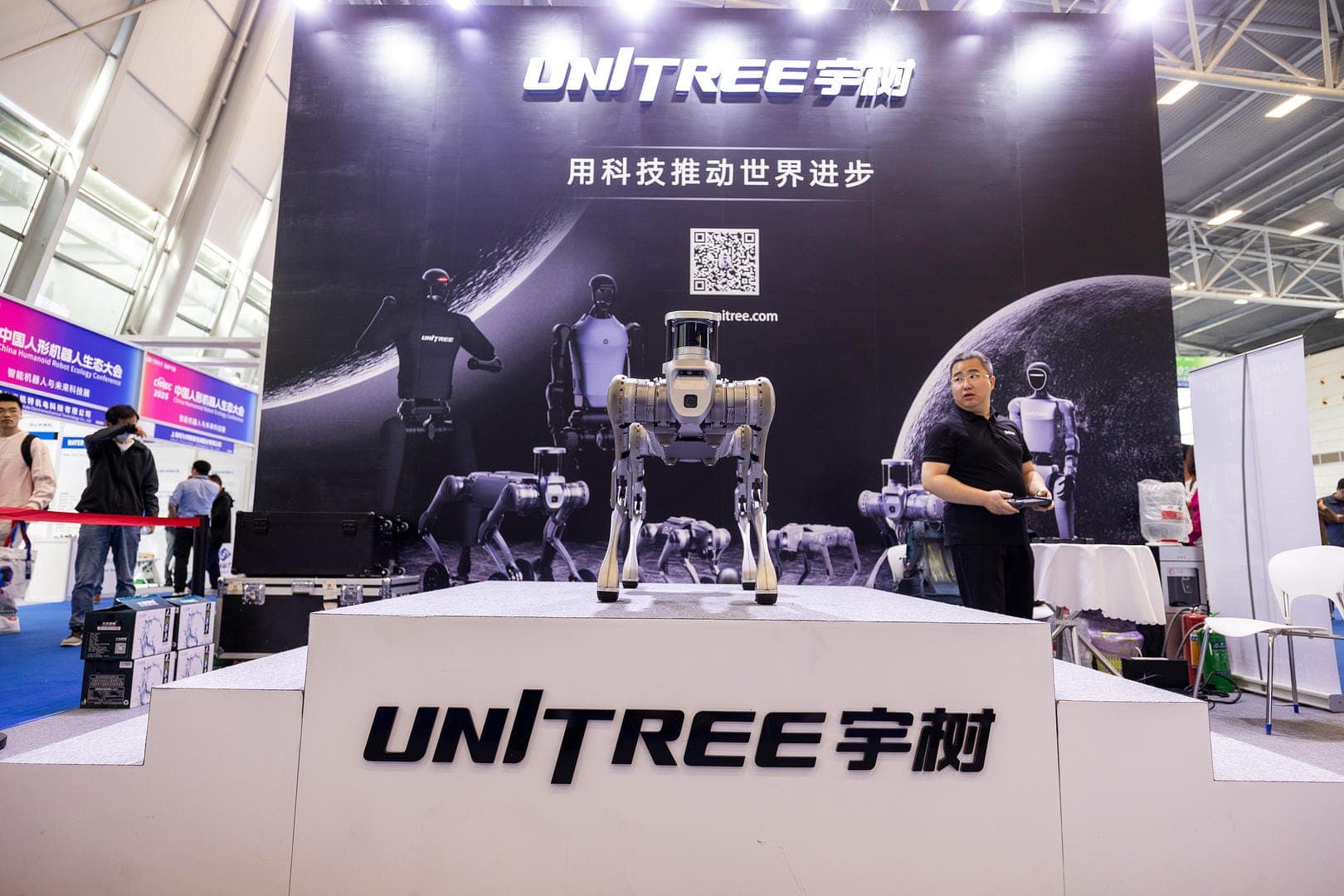
On August 19, Unitree Robotics — the Hangzhou-based maker best known for its backflipping, dancing quadrupeds and now its humanoid line — became the first humanoid robot manufacturer to list on a mainland Chinese exchange. Shares opened 629% above their IPO price on Shanghai’s STAR Market, briefly valuing the company at roughly $66 billion before the stock pulled back to close the day up 460%, around $50 billion. Either number puts Unitree ahead of several already-listed semiconductor firms that debuted on the same exchange this year.
Why this is bigger than a good IPO day
Big first-day pops aren’t unusual in China’s STAR Market — new listings there have averaged a 279% opening gain this year. What makes Unitree different is what it’s actually pricing: not a chipmaker or a software company, but a robotics manufacturer whose core product barely existed as a commercial category five years ago.
That’s the real story here. Every humanoid and robotics company that’s raised money privately — including the ones in portfolios like XMAQUINA’s — has been valued using comparables, projections, and negotiated terms with no public reference point to check against. Unitree’s listing is the first time the public market has said, in real time and with real money, what it thinks a scaled humanoid robotics business is worth. Reports suggest the debut is already being treated as a valuation benchmark for 30 to 50 other robotics companies preparing Hong Kong listings.
The numbers behind the pop
The market reaction wasn’t pure sentiment — Unitree came in with real financials attached:
- Revenue grew from roughly 393 million yuan in 2024 to 1.70 billion yuan in 2025, a compound annual growth rate above 226%
- The company posted a net profit of 278 million yuan in 2025
- It shipped more than 5,000 humanoid units in 2025
- Overseas sales made up about 44% of main-business revenue, with the U.S. flagged in its own prospectus as both a key market and a geopolitical risk
That last point is worth sitting with. Unitree went public naming U.S. trade restrictions as a material risk, just weeks after the FCC added foreign-made humanoid and quadruped robots to its Covered List over national security concerns. Retail demand didn’t seem to care — the IPO was oversubscribed by more than 5,000 times, with roughly 9.8 million retail accounts competing for 9.7 million available shares.
What this doesn’t tell us
A public listing answers “what will the market pay,” not “which technology is actually better” or “which company will still be shipping units in five years.” Unitree’s valuation reflects investor appetite for humanoid robotics as a category right now — a category that, as we’ve covered before, still has enormous gaps between companies publishing verified production data and companies riding demo-reel hype. A $66 billion opening valuation is a data point, not a verdict.
It’s also a single company in a single market. Whether Western humanoid makers — many of which are still privately held — see anything close to this kind of public reception when their turn comes is genuinely unknown. Different regulatory environment, different investor base, different risk appetite.
The takeaway
For anyone tracking robotics as an investment category rather than just a technology story, this is the week the sector got its first real price discovery mechanism. Whether $50–66 billion turns out to be a fair mark or a retail-driven overshoot will take months to know. But the fact that a number now exists at all — set by public markets, not a term sheet — is the actual milestone.