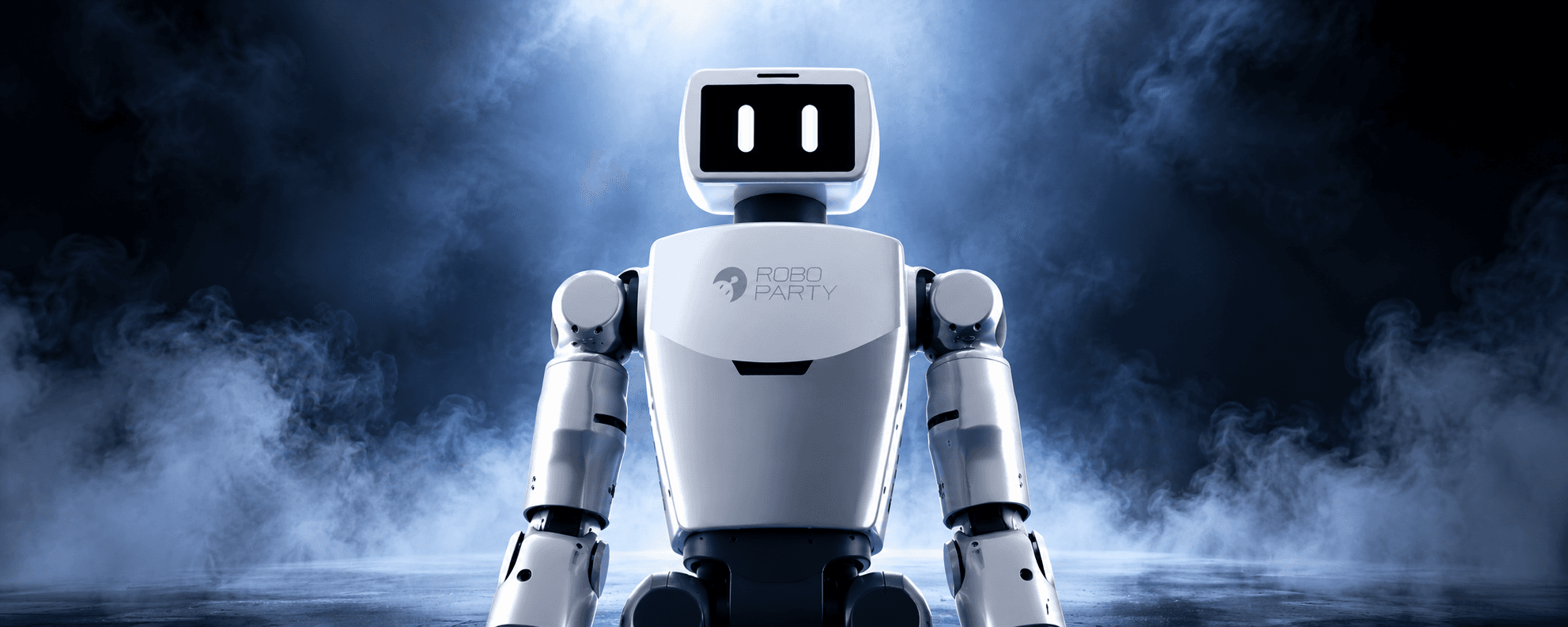

The robot made its public debut at IROS 2026 in Pittsburgh. RoboParty plans to progressively open the platform’s hardware, actuator modules, motion-control systems, simulation environments, SDKs, training tools and PartyOS software foundation.
RP1 delivers peak joint torque of up to 160 Nm and uses actuator modules developed internally by RoboParty. Its control stack integrates the company’s UFO framework, an unsupervised reinforcement-learning system developed to train humanoid locomotion and dynamic behaviours without relying entirely on predefined motion trajectories.
During demonstrations at IROS, visitors were allowed to physically push and kick the robot. RP1 adjusted its posture and recovered its balance following the external disturbances. The demonstrations also included continuous movement and fall recovery.
RoboParty is developing RP1 alongside PartyOS, which combines locomotion, perception, manipulation and embodied AI development tools. The company says the platform is intended to support model training, validation, deployment and robot-data collection rather than operate solely as a closed commercial robot.
The company previously released RPO, its first open-source bipedal humanoid project, in January. RoboParty says RPO has accumulated more than 2,500 GitHub stars, while its broader developer community now exceeds 5,000 members.
RoboParty plans to publish additional details of RP1’s open-source roadmap during October. Broader software and hardware releases are scheduled to follow, with a mass-production program planned for the fourth quarter.
Pricing, initial production volume and delivery dates have not yet been disclosed.