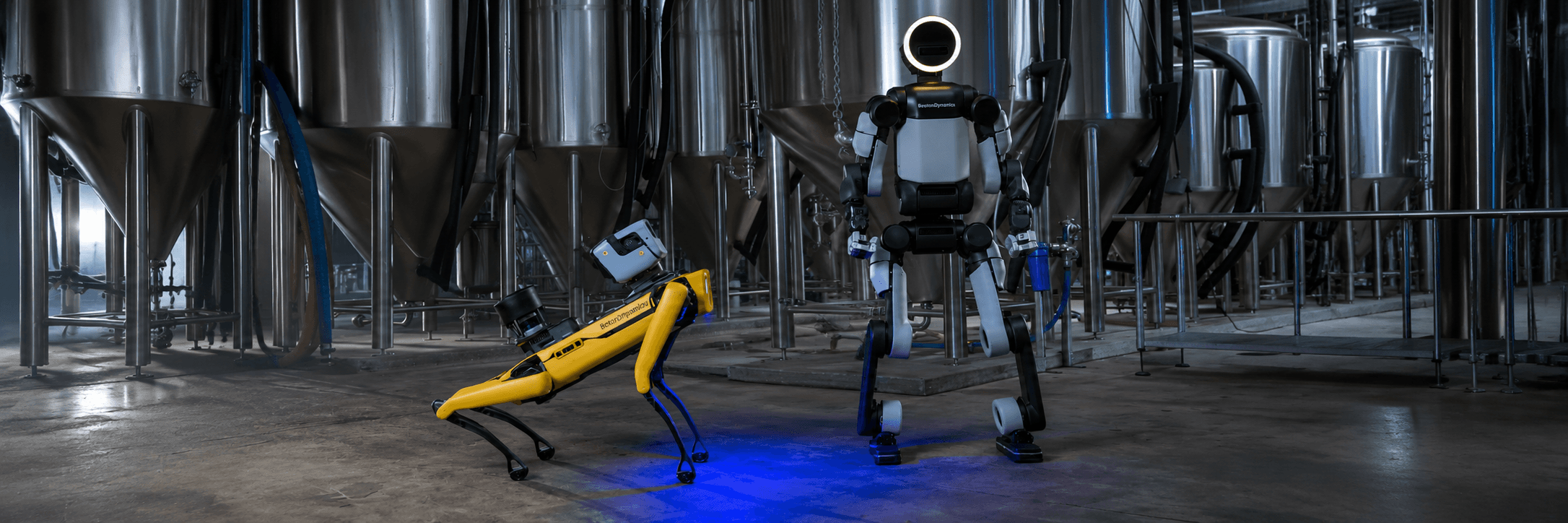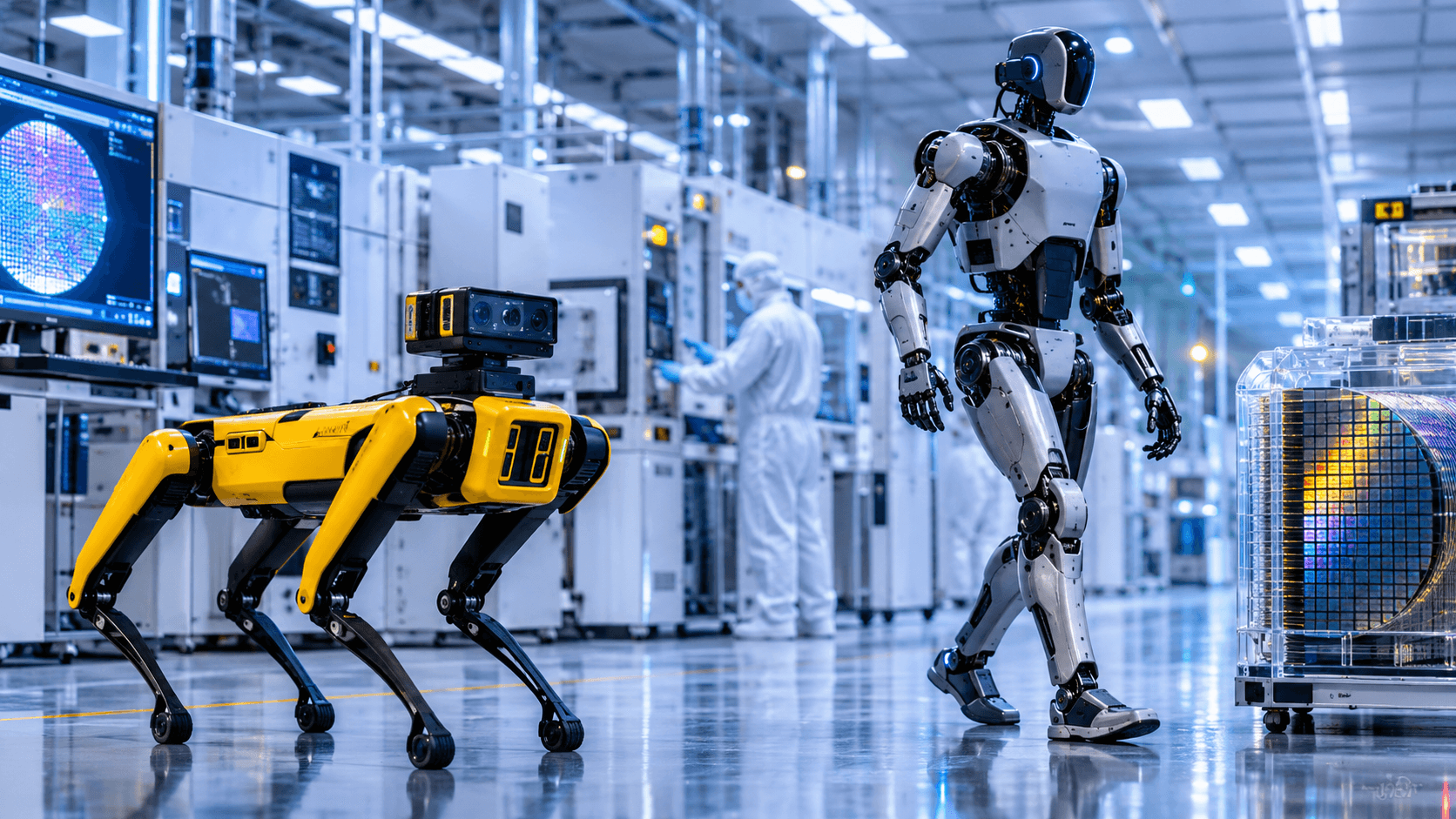

Boston Dynamics is expanding its partnership with GlobalFoundries, bringing Spot robots into more semiconductor manufacturing facilities while preparing to test Atlas in the industry for the first time. The development highlights an emerging opportunity for robotics companies: moving beyond automotive factories and warehouses into some of the world’s most demanding industrial environments.
Humanoid robotics companies have spent years targeting automotive manufacturing, logistics and warehouse operations. But another industry could become an important proving ground for the next generation of industrial robots: semiconductor manufacturing.
On November 17, Boston Dynamics and GlobalFoundries announced an expansion of their robotics collaboration. The agreement will extend Spot deployments across GlobalFoundries’ manufacturing network in the United States, Germany and Singapore. More significantly, GlobalFoundries will become the first semiconductor manufacturer to participate in Boston Dynamics’ Atlas early-adopter program.
Atlas testing is expected to begin in early 2027.
The announcement is more than another partnership between a robotics developer and an industrial customer. It introduces a new environment in which humanoid robots will have to demonstrate their practical value.
And semiconductor manufacturing may be a considerably tougher test than many conventional industrial applications.
Spot Is Already Delivering Measurable Results
The most interesting part of the announcement isn’t actually Atlas. It’s what Spot has already accomplished.
GlobalFoundries has been working with Boston Dynamics for more than four years, initially deploying Spot at its Burlington, Vermont manufacturing facility.
The collaboration has since expanded to Singapore, where two Spot robots have traveled nearly 900 kilometers and completed more than 90,000 inspections since April 2026.
Boston Dynamics reports that these missions achieved a 99% mission success rate.
The company also reported that 875 routine inspections were redeployed in just two weeks using updated hardware and software, with plans to more than double that inspection workload.
These figures provide something important for the robotics industry: measurable operational results rather than demonstrations alone.
Spot is helping GlobalFoundries move toward predictive maintenance by collecting information across thousands of inspection points. Instead of relying exclusively on scheduled or reactive checks, the manufacturer can use collected data to identify potential equipment issues earlier.
This is where industrial robotics becomes economically interesting.
A robot doesn’t necessarily need to replace an entire human job to create value. If it can perform repetitive inspections consistently, collect useful information and help prevent unexpected equipment downtime, it can improve the productivity of an existing workforce.
Source: Boston Dynamics and GlobalFoundries partnership announcement
Why Semiconductor Factories Are Different
Semiconductor manufacturing is among the most complex industrial processes in the world.
Unlike a typical warehouse, where robots primarily move products between locations, semiconductor facilities operate under highly controlled conditions involving specialized equipment, sensitive materials, environmental controls and strict production requirements.
Even relatively small operational disruptions can become expensive.
Manufacturers therefore place enormous importance on equipment reliability, process consistency and maintenance.
This creates an interesting opportunity for robotics.
Mobile robots can inspect difficult-to-access areas, collect information from equipment and help maintenance teams identify potential problems before they interrupt production.
However, semiconductor facilities also introduce challenges that robotics companies cannot simply ignore.
Cleanroom requirements, restricted access, interactions with manufacturing equipment, worker safety and environmental conditions all influence how robots can be deployed.
In fact, SEMI, the global semiconductor industry association, has been developing a dedicated safety guideline for autonomous mobile robots in semiconductor manufacturing.
The proposed guideline addresses gaps in existing general industrial robot safety standards, including the specific hazards and operating conditions found in semiconductor facilities.
This highlights an important point: successful robotics deployment requires more than navigation and automation capabilities. Robots must also operate within the technical and safety requirements of the industries they serve.
Source: SEMI proposed semiconductor AMR safety guideline
Atlas Is Entering a Different Kind of Industrial Environment
Spot’s established inspection work provides a foundation for the partnership, but Atlas represents a much bigger experiment.
Boston Dynamics plans to begin onsite Atlas testing at GlobalFoundries facilities in early 2027.
The initial program will evaluate potential humanoid applications, customer readiness, integration requirements and task-specific training.
Importantly, this is an early-adopter and skills-development program, not confirmation of a large-scale commercial deployment.
The companies have not yet disclosed the number of Atlas robots involved or a finalized list of production tasks.
That distinction matters.
Spot is already performing defined inspection activities. Atlas must now demonstrate whether a humanoid platform can safely and reliably handle useful tasks in an entirely different manufacturing environment.
The potential advantage of a humanoid robot is its ability to interact with spaces and equipment originally designed around human workers.
It could eventually perform certain material-handling activities, move objects between workstations or assist with tasks requiring more flexible physical interaction.
These are potential applications, not confirmed assignments for the GlobalFoundries trial.
The important question is whether Atlas can deliver enough flexibility to justify the additional complexity and cost of a humanoid platform.
The Opportunity Goes Beyond Replacing Human Labor
One mistake in discussions about humanoid robotics is assuming that every successful deployment must involve replacing a human worker.
Industrial automation is often more valuable when it improves existing operations.
Consider a semiconductor facility with hundreds of machines and thousands of inspection points.
Some maintenance activities require employees to travel between locations, collect readings, examine equipment and document findings.
Robots could potentially take over portions of these repetitive activities while allowing engineers and technicians to focus on troubleshooting, maintenance decisions and more complex work.
That creates a different business case.
Instead of measuring success only through labor replacement, manufacturers can evaluate improvements in:
- Equipment uptime and reduced unplanned downtime.
- Inspection coverage and frequency.
- Early detection of equipment abnormalities.
- Worker exposure to difficult or potentially hazardous environments.
- Maintenance efficiency and operational consistency.
For robotics manufacturers, this also opens the possibility of selling solutions based on measurable operational improvements rather than simply selling machines.
GlobalFoundries Is Already Building an AI-Driven Manufacturing Ecosystem
The Boston Dynamics partnership also fits into a broader digital transformation strategy at GlobalFoundries.
In October 2026, the company opened an Advanced Facilities Control Centre in Singapore, developed with Siemens.
The center integrates facilities operations and data, enabling continuous equipment health monitoring and more centralized management.
GlobalFoundries also describes using autonomous robots equipped with technologies such as thermal imaging, gas detection and vibration-acoustic sensing to conduct inspections and transmit information for analysis.
This is significant because industrial robotics becomes more useful when connected to a wider operational intelligence system.
A robot collecting information is only one part of the process.
That information needs to reach the appropriate systems, be interpreted correctly and support decisions that improve manufacturing operations.
Combining mobile robotics, sensors, AI-based analysis and centralized monitoring could create a more comprehensive approach to predictive maintenance.
In this environment, robots are not isolated machines. They become part of the facility’s broader digital infrastructure.
Source: GlobalFoundries Advanced Facilities Control Centre
What This Means for the Robotics Market
The expansion into semiconductor manufacturing could have implications beyond Boston Dynamics.
The industry has largely focused on automotive production and warehouse logistics as early markets for humanoid robots.
Those environments provide relatively clear use cases, including moving materials, handling components and supporting repetitive production activities.
Semiconductor manufacturing introduces another potential market, but one with different requirements.
Robotics companies entering this sector may need to demonstrate:
Higher operational reliability: Robots must perform their assigned activities consistently without disrupting sensitive production processes.
Better environmental awareness: Systems need to recognize equipment, restricted areas, workers and changing operating conditions.
Stronger integration: Robots must communicate effectively with existing manufacturing and facility-management systems.
Clear economic value: Customers need evidence that the technology improves productivity, maintenance efficiency or operational reliability.
Safety and compliance: Deployments must meet the requirements of specialized industrial environments.
These requirements could create opportunities for robotics companies developing advanced sensing, manipulation, autonomous navigation and physical AI technologies.
However, entering a new industry does not automatically translate into commercial success.
Each application must demonstrate that the robot can perform a useful task at a competitive cost.
Spot’s Results May Be More Important Than Atlas’ First Demonstration
There is a broader lesson in this partnership.
The robotics industry frequently attracts attention through new humanoid demonstrations, improved mobility and increasingly sophisticated AI capabilities.
But the more important developments may be happening in less visible industrial environments.
Spot’s 90,000 inspections and 99% mission success rate provide an example of how robotics can generate measurable operational value.
Atlas, meanwhile, is entering a new testing environment where its capabilities and limitations will become clearer through real-world evaluation.
The two robots represent different stages of industrial robotics adoption.
Spot demonstrates the value of specialized mobile automation in an established application.
Atlas represents the possibility of expanding automation into tasks that may require greater physical flexibility.
Neither approach needs to replace the other.
In fact, industrial facilities may eventually rely on several types of robots working together, with each platform assigned to tasks suited to its capabilities.
The Next Robotics Competition Will Be About Operational Results
Boston Dynamics’ partnership with GlobalFoundries is worth watching because it moves the robotics conversation into another important industrial sector.
The expansion of Spot demonstrates that robotics can deliver measurable results in semiconductor facilities.
The upcoming Atlas program will test whether humanoid robots can find similarly valuable applications in an environment with demanding technical and operational requirements.
But the real measure of success will not be how impressive Atlas looks during its first demonstration.
It will be whether the robot can perform useful tasks consistently, integrate into existing operations and generate enough economic value to justify broader adoption.
If the program succeeds, semiconductor manufacturing could become another meaningful market for humanoid robotics.
If it encounters significant limitations, that will still provide valuable information about where humanoids fit within industrial automation.
The future of robotics will not be determined by which robot looks the most human. It will be determined by which machines can solve real industrial problems reliably, safely and economically.