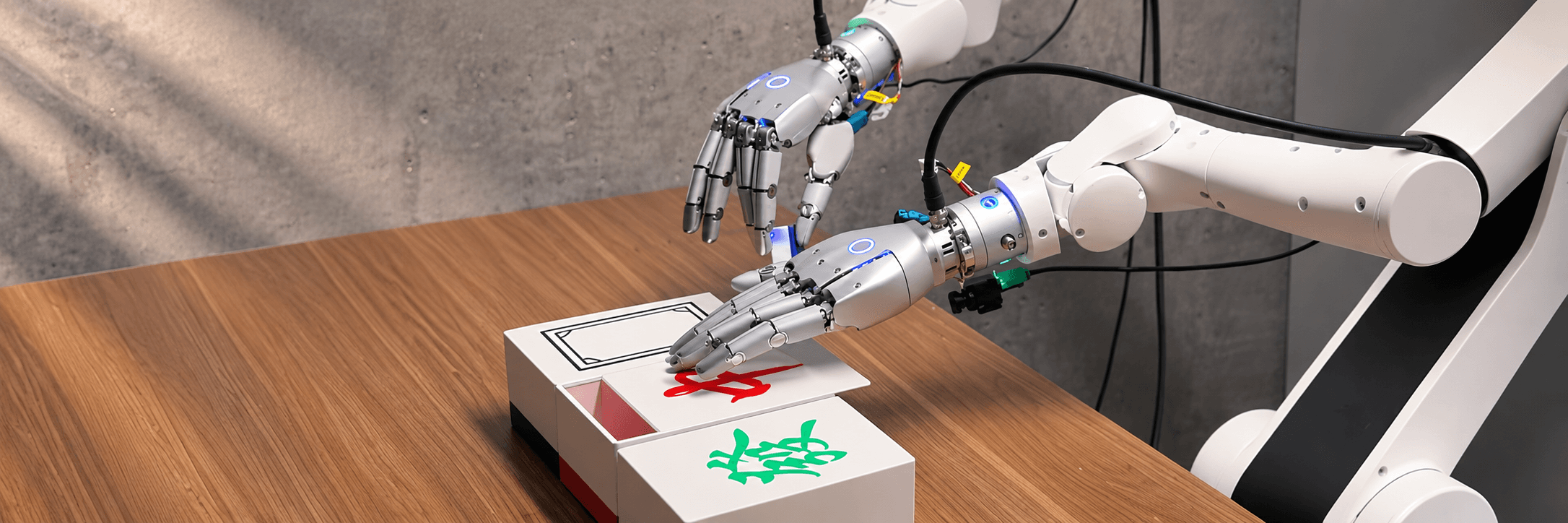

A robot can see a key, understand an instruction to turn it and still fail at the moment its fingers make contact. Panasonic and a group of university and industry researchers are tackling that gap with T-Rex, a new manipulation system that gives robotic hands a faster response to touch.
Announced on November 5, Tactile-Reactive Dexterous Manipulation, or T-Rex, combines a vision-language-action model with fingertip sensors that detect changing contact conditions. The work was developed by Panasonic Holdings and Panasonic R&D Company of America with researchers from the University of California, Berkeley, NVIDIA, Stanford University, Sapienza University of Rome and ItalAI. The team plans to present its findings at the Conference on Robot Learning in Austin, Texas, from November 9 to 12.
Most vision-based robot controllers generate actions from camera images and instructions, but those signals can be too slow when an object slips or bends. T-Rex separates the process into two speeds. Its vision-and-language component plans broad movements at approximately five updates per second, while a tactile component makes corrections at roughly 20 updates per second. That faster feedback helps the robot adjust its grip without waiting for another full visual analysis.
The researchers evaluated the system on 12 real-world manipulation tasks that demand careful force control, including turning pages, transferring eggs, unlocking with a key, removing a card and screwing in a light bulb. Panasonic reports an average success rate of 65%, compared with 35% for the strongest baseline in its tests. Removing tactile information reduced T-Rex’s average success rate to 42%, suggesting that touch feedback made a measurable contribution.
Training drew on 22,889 hours of first-person human video and a separate collection of more than 7,700 robot manipulation episodes, totaling about 100 hours. That robot dataset covered over 200 everyday objects and 22 basic actions, with synchronized camera footage, robot movements, language instructions and tactile measurements from ten fingertips. The system was then fine-tuned using approximately 100 demonstrations per task.
T-Rex is a research system, not a newly launched commercial robot or a confirmed factory deployment. Panasonic says potential applications include inserting and removing components, fastening parts and handling soft or fragile goods in manufacturing and logistics. The published results establish a laboratory benchmark for contact-rich manipulation; performance in sustained industrial operation remains to be demonstrated.