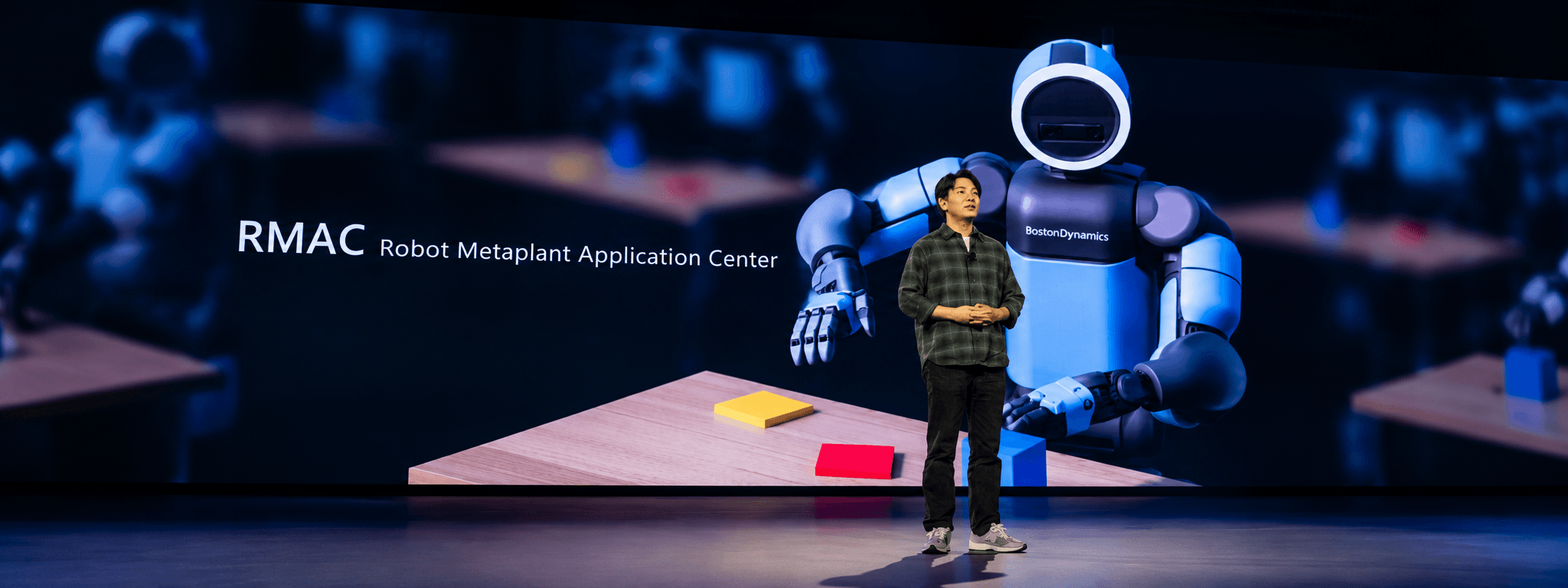

Boston Dynamics has put wheels on its Atlas humanoid, but the unusual configuration is not intended for sale. In a research demonstration released November 9, the company showed Atlas rolling, sliding sideways and completing a jumping 360-degree turn while engineers tested the interaction between motor hardware and reinforcement-learning control.
The experiment began with a simple modification. Controls engineer Xiaoyu (Andy) Wu attached off-the-shelf scooter wheels to Atlas’s existing ankle actuators using a custom adapter. Boston Dynamics says that adapter was the only new hardware component. In the robot’s software, the team represented each wheel as an ankle capable of continuous rotation, allowing researchers to adapt the existing whole-body control framework rather than build a separate system.
The objective was to stress-test the actuators under sustained high torque and speed while carrying the robot’s weight. Unlike conventional walking, wheeled movement repeatedly pushes motors through demanding combinations of acceleration, braking and turning. Wu also wanted to establish whether a policy trained in simulation could reproduce its movements reliably on physical hardware.
To improve that transfer, engineers measured the real motors’ behavior and adjusted their simulation models accordingly. Reinforcement learning then produced smooth rolling and unexpected movement strategies. During sideways dashes inspired by human motion-capture data, the controller learned to use the wheels rather than imitate foot sliding. A jumping 360-degree rotation, trained from a recorded human trajectory, succeeded on the first physical attempt, according to the company.
Boston Dynamics explicitly describes wheeled Atlas as a research testbed, not a commercial robot or a replacement for the standard bipedal platform. The team says lessons from the experiment are already being applied to the conventional Atlas configuration, particularly to improve how actuator dynamics and whole-body learning work together.