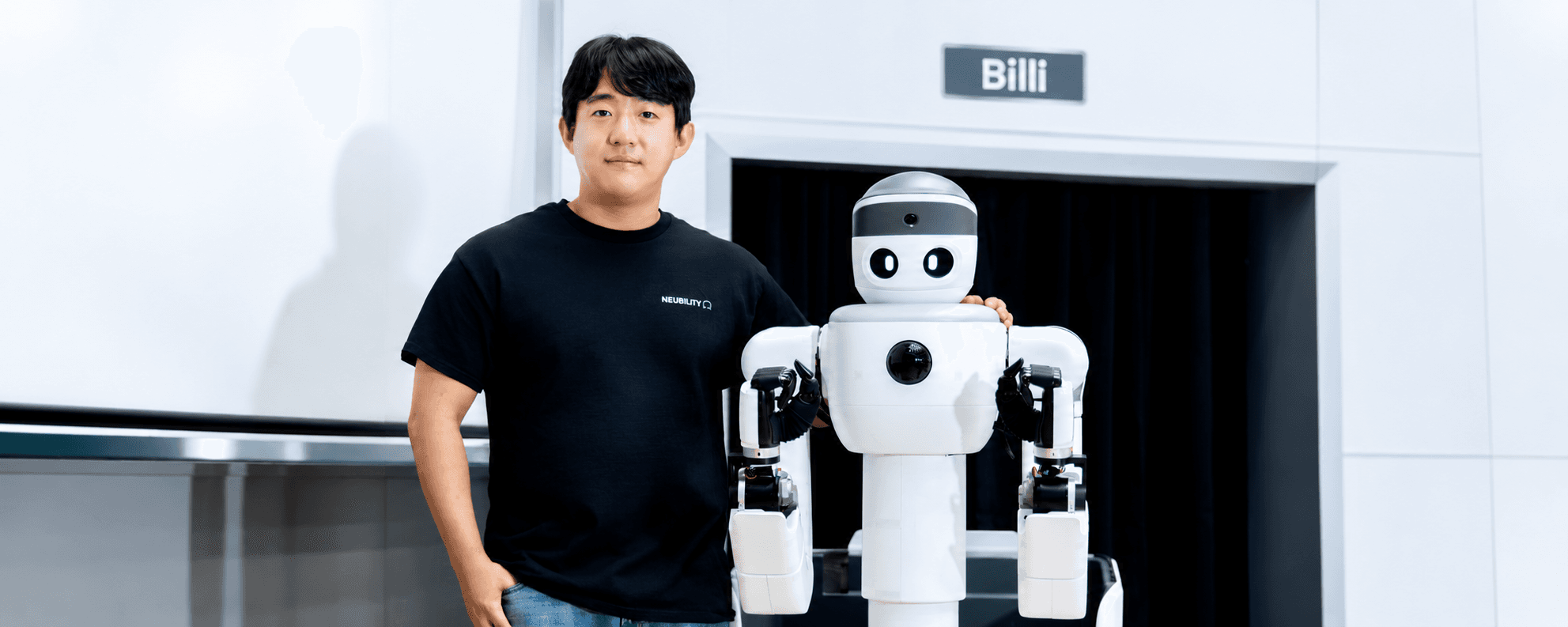

Billi combines a humanoid upper body with a four-wheel mobile base. It has two arms equipped with five-finger robotic hands, 16 degrees of freedom and an upper body capable of rotating 360 degrees. The robot reaches a maximum height of 1.497 meters.
Neubility demonstrated Billi autonomously approaching a shelf, picking up a box with both hands, rotating its torso and placing the box into a rear storage compartment.
The robot can lift objects weighing less than 15 kilograms and transport up to 60 kilograms in its rear cargo area. Battery life is listed at four to six hours. Neubility is using camera-based navigation rather than LiDAR, extending the vision-based autonomy approach developed for its existing delivery robots.
The company says its existing fleet has generated real-world spatial data from hundreds of robots operating at more than 150 sites. Its current website reports more than 146,000 kilometers of autonomous driving and 23,000 completed missions. Billi is now moving into industrial testing. Neubility plans proof-of-concept programs with four companies, including CJ CheilJedang. One robot is scheduled to enter a CJ food manufacturing facility this year to test automated ingredient sorting before the companies consider broader deployment.
Neubility plans to begin mass production in the second half of 2027 and is targeting production capacity of several hundred units within two years.