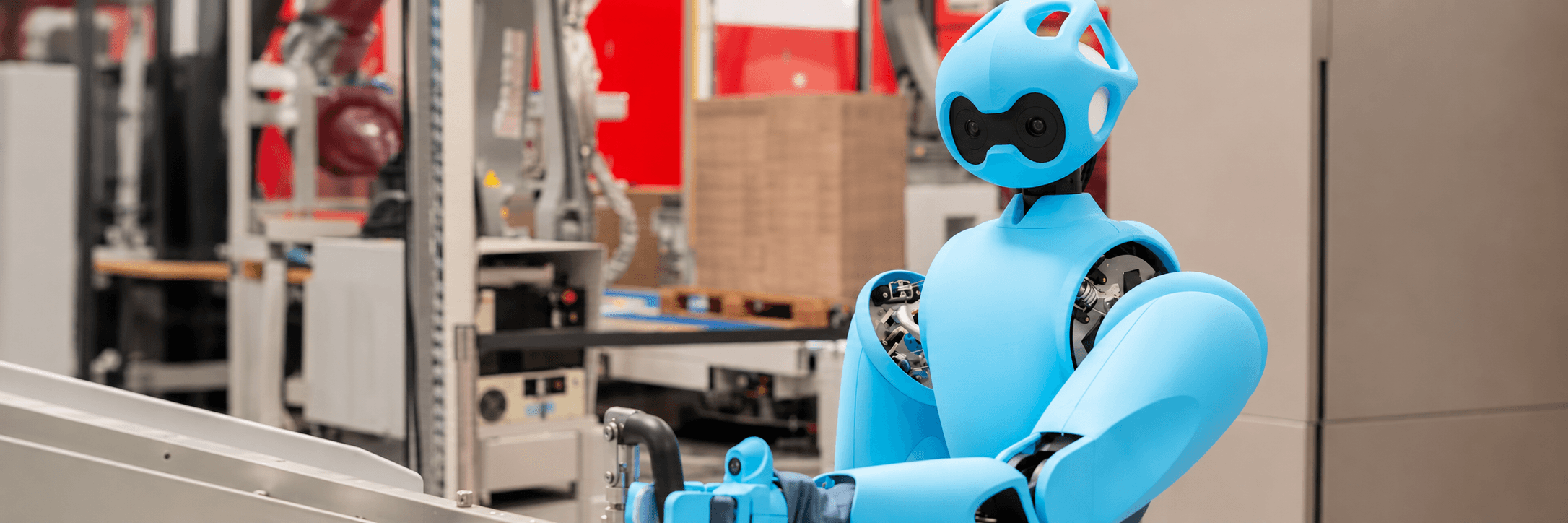

Swiss robotics startup Embodied AI has unveiled AIR, a wheeled, dual-arm humanoid designed to work alongside factory employees without the protective cages typically required around industrial robots. The company presented the new machine at Humanoid Europe 2026 in Munich on November 6.
AIR is built around a different physical design from many industrial robots. Heavy components are concentrated in its torso, while its lightweight, compliant arms are designed to yield on contact. Embodied AI says this approach allows the robot to share working space with people while handling repetitive tasks that are difficult to automate using fixed machinery.
The company was spun out of EPFL, the Swiss Federal Institute of Technology in Lausanne, and is led by co-founder and CEO Francesco Stella. It says the robot was developed in nine months, drawing on research into compliant robotic arms. Co-founders Kai Junge and Max Polzin bring additional robotics research experience from European universities.
AIR is intended to learn work directly on the factory floor. A remote operator initially guides the machine through a task, producing examples that its software uses for training. Embodied AI says the robot can begin taking over the task within approximately one month. Rather than relying on one general-purpose model, the company uses a collection of task-specific AI models.
Embodied AI reports an average task success rate of 95% across paid industrial pilots involving manufacturers in consumer electronics and automotive-related sectors. That figure is company-reported, and the startup has not disclosed the number of tasks tested, the duration of the pilots or its measurement methodology. Its software has also been used in a separate two-arm robotic workcell already operating on a customer production line.
The company says it has signed contracts with major original equipment manufacturers and plans to open orders following the Munich unveiling. Pricing, production capacity and a delivery timetable have not yet been announced.
AIR enters a growing field of mobile manipulation robots being developed for factories where work changes too frequently for conventional automation. Its commercial progress will depend on whether the training process and safety approach demonstrated in early pilots can be repeated reliably across customer sites.