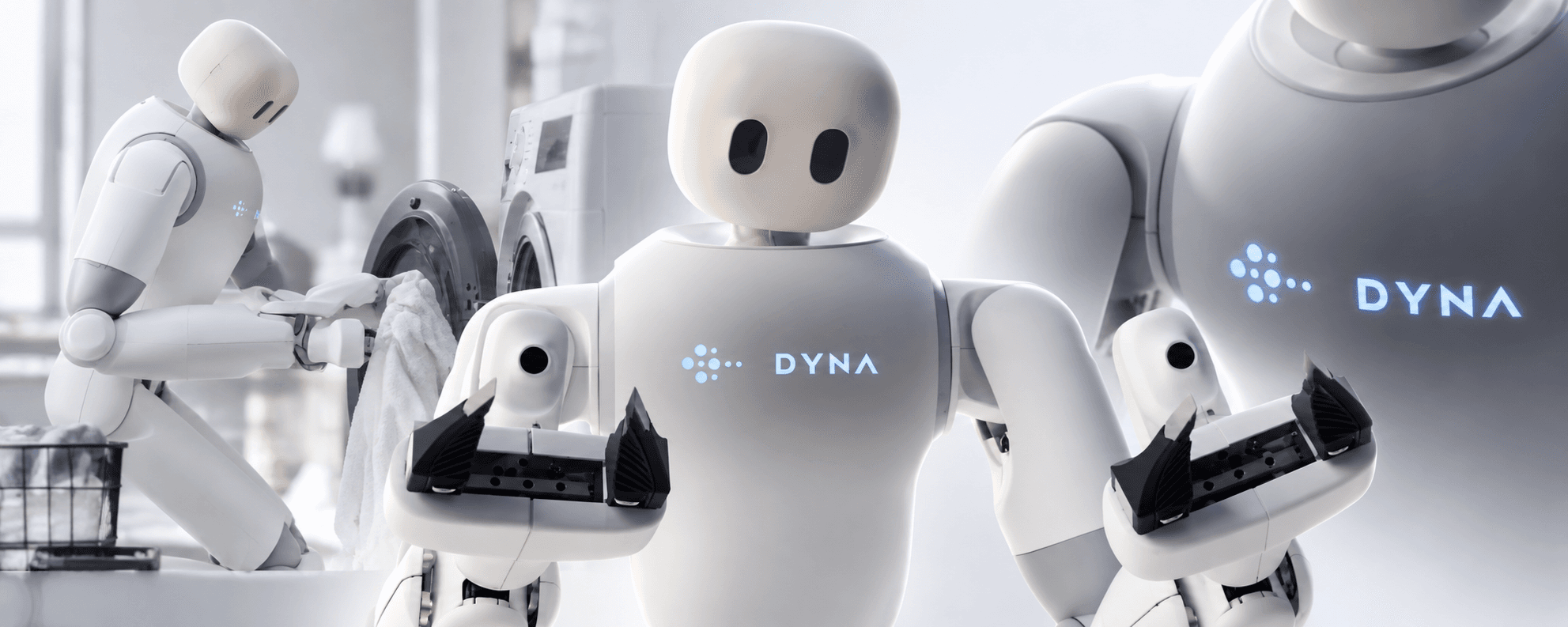

The robot was introduced alongside DYNA 2.1, the company’s new physical-agent system. In its first demonstration, Taku autonomously completed an hour-long commercial laundry workflow involving washing, drying, folding and shelving towels.
Taku combines a human-shaped upper body with two seven-degree-of-freedom arms, a folding lower body and four steerable wheels. DYNA says it chose wheels because the commercial environments it is targeting require mobility, reach and manipulation more often than legged locomotion.
The articulated body allows the robot to reach into washing machines and dryers, work at tables, crouch toward lower shelves and reach above its head. Its arms use low-ratio planetary actuators designed to support higher speeds and accelerations than conventional harmonic-drive arms.
DYNA 2.1 separates physical control and workflow planning across three model layers. A whole-body controller trained through reinforcement learning coordinates the robot at 100 Hz. DYNA-2, the company’s world-action model, generates whole-body movement targets, while a vision-language orchestrator tracks the workflow, maintains memory and determines what the robot should do next.
During the laundry demonstration, Taku loads and operates machines, transfers towels between stations, folds and sorts them, and places finished stacks onto shelves. The system also handles errors including dropped towels and failed grasps without requesting human assistance.
DYNA says its earlier stationary systems could perform individual tasks reliably but still required people to manage the surrounding workflow. Taku and DYNA 2.1 are designed around longer periods of autonomous operation, with the company measuring Mean Time Between Interventions rather than individual task success rates.
DYNA says its next step is deploying the new system at customer sites. The company is already deploying robotics systems across hotels, laundromats and restaurants.