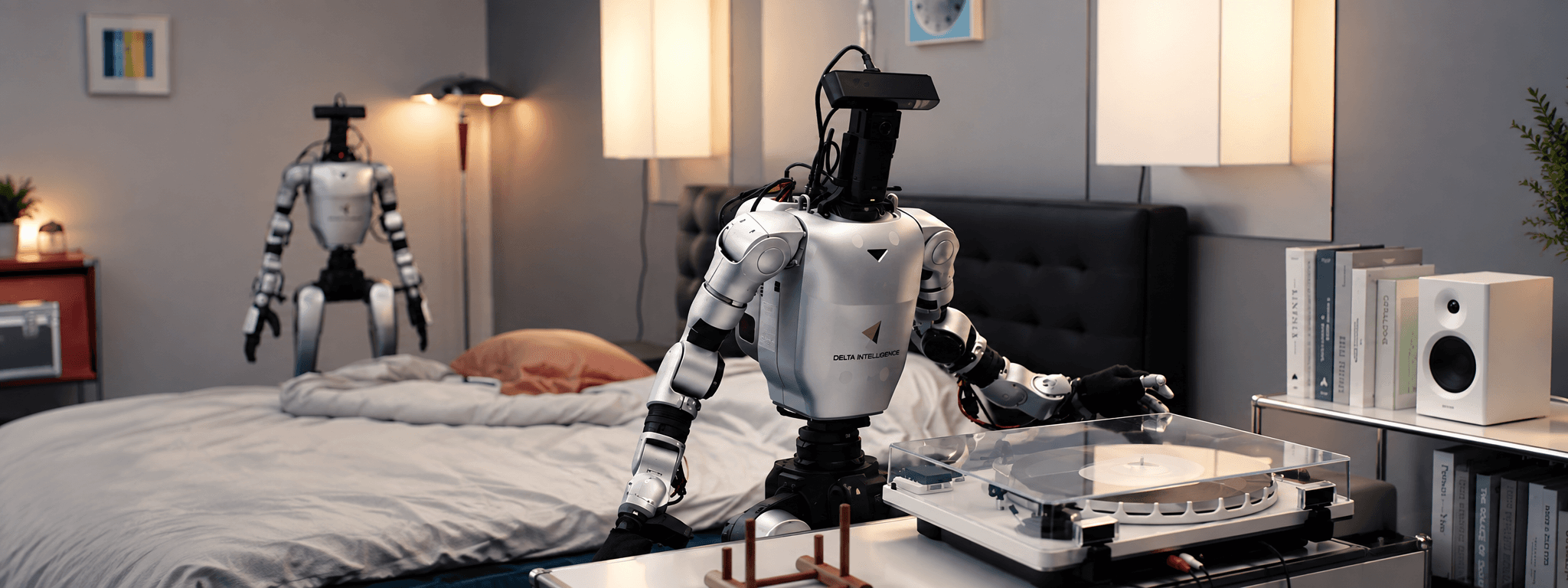

In its first full demonstration, the model controlled 69 degrees of freedom while a humanoid completed nine household tasks across 32 planned steps in approximately 210 seconds. Delta says the sequence was fully autonomous and recorded as a single continuous take without teleoperation or video cuts.
The demonstration moves through a bedroom, living room and kitchen. Tasks include putting away a game console, making a bed, picking up a toy, loading clothing into a washing machine, placing a cup in a dishwasher, opening a refrigerator, identifying and removing spoiled fruit, operating a pedal bin and sitting on a sofa.
Delta trained Δ₀ using human first-person observations and whole-body motion data collected through its D1 data-capture system, alongside additional motion datasets. Its training pipeline combines pretraining on human-centered data with physical interaction feedback, human corrections and reinforcement learning during post-training.
The company also uses a real-to-simulation-to-real evaluation process. Physical environments are reconstructed in simulation, where the humanoid repeatedly performs navigation and manipulation tasks before policies are returned to physical hardware for validation.
Delta reports an 89% success rate in a dishwasher-loading evaluation. That figure is a company-reported research result and should not be interpreted as a measure of reliability in commercial deployment. Founder and CEO Xiaojian Ma said Delta’s near-term commercial focus includes energy and infrastructure environments. The company is also developing a head-and-backpack system intended to deploy its models across different humanoid platforms and is working with partners on complete bipedal robots.