

Two things happened in China’s robotics industry within the space of a single week in August, and together they say more about where humanoid robots actually stand than either story could on its own.
First, Unitree Robotics — the Hangzhou company best known for the dancing, backflipping robots that populate half of your social media feed — went public on Shanghai’s STAR Market and had one of the wildest trading debuts anyone in the exchange’s history can remember. Then, three days later, at a five-day robot olympics in Beijing, one of Unitree’s own machines came dead last in the very event category the company built its brand on.
It’s a tidy illustration of an industry that is simultaneously overheating financially and still, quite literally, learning to walk.
A $50 Billion Debut, Built on $250 Million of Revenue
Unitree listed on August 19, pricing its shares at 150.80 yuan (about $22) to raise roughly 6.1 billion yuan, or $904 million. Retail demand was reportedly oversubscribed by more than 5,000 times. When the stock actually started trading, it opened by rising as much as 629% intraday before settling into a close of about 460% above the offer price — a first-day pop so large it dwarfed the average 279% gain other Chinese IPOs had managed so far in 2026, and it happened on a day the broader Shanghai market was falling roughly 3%.
By the closing bell, Unitree — officially Yushu Technology Co. — carried a market value estimated between $50 billion and $66 billion depending on which day’s price and exchange rate you use. That put it ahead of established Chinese tech names like Baidu and JD.com, and made 36-year-old founder Wang Xingxing’s stake worth well over $14 billion on paper.
For context on just how far ahead of fundamentals that valuation runs: Unitree reported about 1.7 billion yuan ($252 million) in 2025 revenue and roughly 600 million yuan ($89 million) in profit. It shipped around 5,500 humanoid robots in 2025 and about 18,000 units across its full robot lineup by mid-2026 — genuinely the leading shipment numbers in the industry, but numbers that leave the company trading at a price-to-earnings ratio some analysts have pegged near 1,300x. Backers in the deal included Chinese AI lab DeepSeek, with Tencent holding a stake from earlier funding rounds.
The listing is being treated as a bellwether. It’s the first pure-play humanoid robotics company to get a public, market-set price anywhere in the world, and Wall Street is already using it as the yardstick against which to measure U.S. players like Figure AI (last valued privately near $39 billion) and Agility Robotics, which is heading toward a SPAC listing at a far more modest implied $4 billion.
Then, Days Later, Unitree’s Robot Finished Last
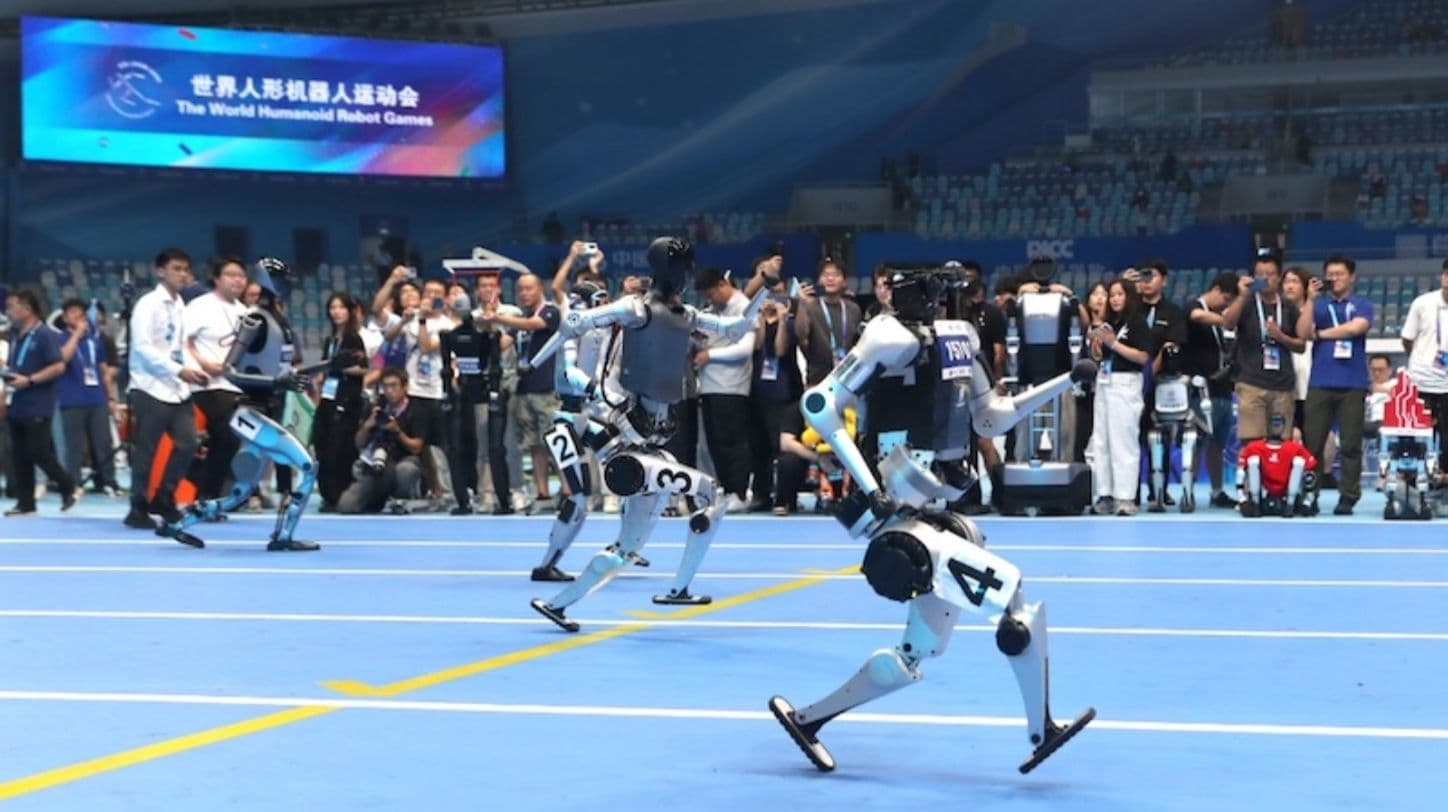
If the IPO was Unitree’s victory lap, the second World Humanoid Robot Games — held August 22–26 at Beijing’s National Speed Skating Oval — was a reminder that stock prices and athletic performance are not the same thing.
The Games had quadrupled in scale from their 2025 debut: 2,056 robots from 666 teams competed across 51 events, ranging from track and field to football, tai chi, firefighting drills, and simulated hotel housekeeping. The marquee event, again, was the 100-meter dash — and again, a robot beat Usain Bolt’s 9.58-second human world record, repeatedly.
Tiangong Ultra, built by the state-linked Beijing Humanoid Robot Innovation Center (operating as X-Humanoid), opened the Games with a 9.39-second heat, then kept shaving the record down across the week: 9.34, then 9.32, then 8.86 in the semifinal, and finally 8.64 seconds in the closing-night final — nearly a full second faster than Bolt, and light-years ahead of the 21.50-second time that had won the same event just a year earlier. Rival Honor’s Lightning stayed close throughout, running 9.47 in the final after clocking 9.32 in pre-Games testing, and separately holds the record for the fastest humanoid half-marathon (50:26, set in April 2026).
Unitree, fresh off the biggest IPO pop of the year, ran 12.41 seconds in the opening heat — last place, more than three seconds behind the leaders, and outside the podium picture for the rest of the meet. It was a pointed reminder that the company’s commercial dominance in unit shipments doesn’t automatically translate into best-in-class hardware performance in every category. Meanwhile, AgiBot — a comparatively quiet name outside China — topped the overall medal table with 46 medals, built mostly on dexterity and “scenario” events like firefighting and library-sorting tasks that look a lot more like the jobs these robots are actually being built to do.
Why Both Stories Matter Together
Put side by side, the IPO and the Games tell a story that’s easy to miss if you only read one headline: China’s humanoid robot sector is scaling in manufacturing and capital markets far faster than it is converging on which company actually builds the best robot. Unitree can be simultaneously the shipment leader, a $50-billion-plus public company, and a laggard in a straight-line footrace against robots built by a state research center and a rival hardware maker.
It also underlines a broader, less flattering pattern industry analysts have been flagging all year: widely-repeated deployment figures for humanoid robots — Tesla’s Optimus, Figure’s warehouse units, and others — routinely turn out not to originate from the companies themselves, and Chinese manufacturers currently account for roughly 97% of global humanoid shipments in the first half of 2026, even as profit margins for the shipment leader are reportedly getting squeezed rather than improving.
The next edition of the World Humanoid Robot Games is already scheduled for Beijing in August 2027, with organizers promising an even heavier emphasis on scenario-based, work-like tasks rather than pure athletics — a signal that even the event’s own organizers know that running fast isn’t the point.