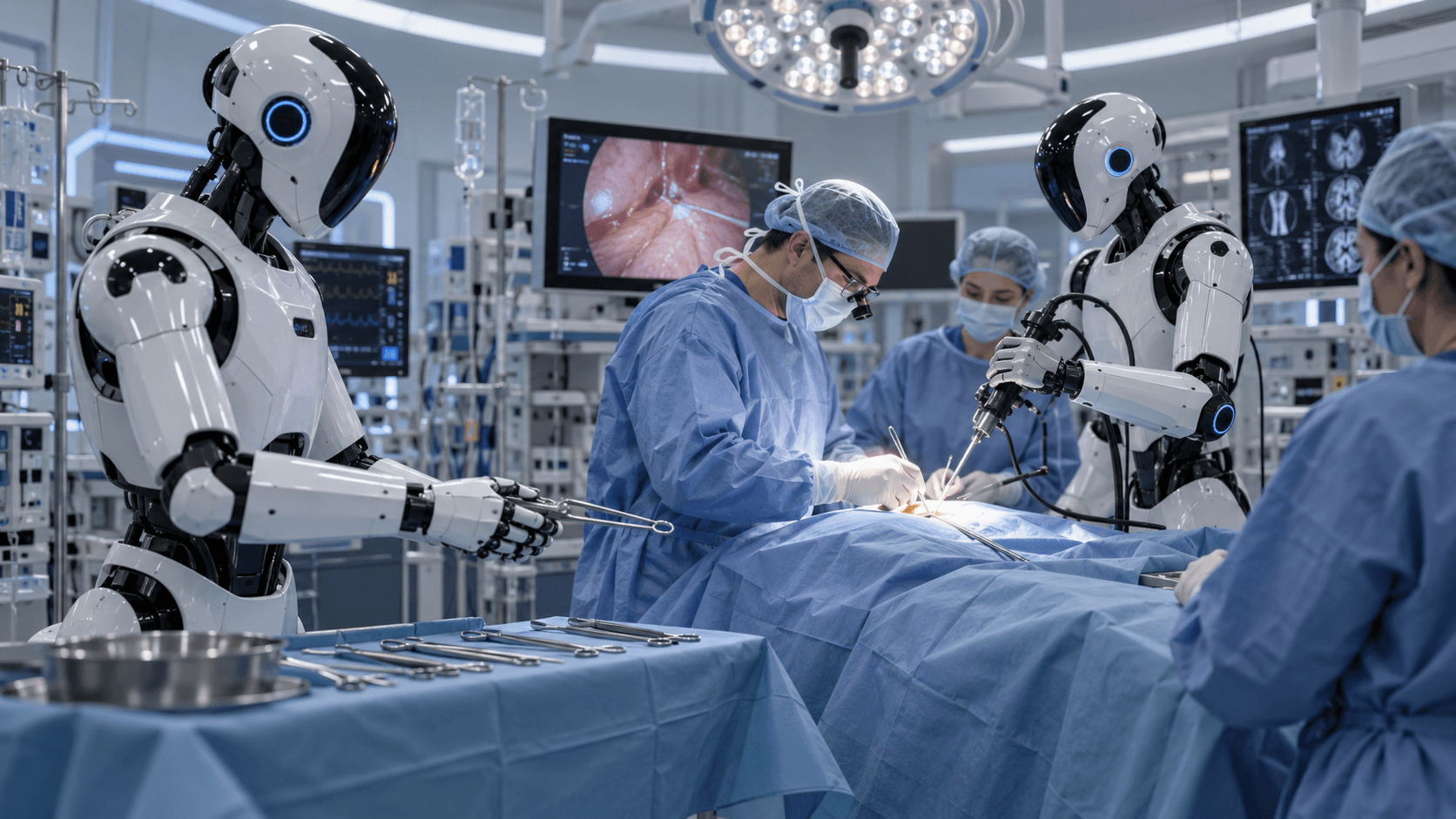

Samsung Medical Center is preparing to demonstrate two humanoid surgical assistant robots working alongside a human surgeon, exploring how Physical AI could eventually support instrument handling, endoscope control and other operating-room tasks.
Humanoid robots are beginning to move into an environment far more demanding than a warehouse or factory floor: the operating room.
Samsung Medical Center has announced plans to publicly demonstrate a pair of humanoid surgical assistant robots on September 16, 2026, as part of South Korea’s Korean ARPA-H research program.
The robots are being developed by the ORchestra consortium, led by Samsung Medical Center and involving Rainbow Robotics, AIDIN Robotics, Hahaeho, Samsung Advanced Institute for Health Sciences and Technology, Seoul National University, the National Cancer Center and Jeonbuk National University Hospital.
The project is exploring whether humanoid machines can assist medical staff while working inside an operating room already designed around humans.
Two Robots Working Alongside One Surgeon
Rather than demonstrating a single robotic arm performing a narrowly defined procedure, the project is testing how multiple humanoid robots could divide operating-room responsibilities.
During the planned demonstration, one robot will perform tasks similar to those of an operating-room nurse, including handling and retrieving surgical instruments.
A second robot will take on functions associated with both a surgical assistant and nursing staff, such as manipulating an endoscope and assisting with tissue retraction.
The system will also demonstrate robots responding to voice commands from medical personnel.
This does not mean the robots are independently performing surgery.
Samsung Medical Center has emphasized that the technology is still being evaluated in a simulated research environment. Some surgical movements are teleoperated, with a human surgeon’s motions translated into commands performed by the humanoid robot.
That distinction is important as increasingly capable robotics systems enter healthcare.
Why Use a Humanoid?
Surgical robots are not new.
Systems using specialized robotic arms have already transformed areas of minimally invasive surgery. But those machines are generally designed around specific procedures and dedicated operating-room configurations.
Humanoid robots present a different possibility.
Operating rooms already contain instruments, equipment and workspaces designed around the dimensions and movements of human medical staff.
A humanoid robot capable of using those same tools could potentially enter an existing workflow without requiring the entire room to be redesigned around automation.
That could allow robots to perform supporting activities such as passing instruments, maintaining an endoscopic view or holding tissue while surgeons concentrate on the most complex parts of a procedure.
The ORchestra project is therefore not simply investigating whether a robot can manipulate a surgical instrument.
It is studying whether several robots and humans can coordinate as one surgical team.
Physical AI Enters Healthcare
The project also represents another example of Physical AI expanding beyond manufacturing and logistics.
A robot assisting with surgery must combine several capabilities at once.
It needs precise manipulation, force control, visual perception, reliable communication and an understanding of the sequence of actions taking place around it.
Mistakes that might simply stop a warehouse automation process could carry much greater consequences in a medical environment.
Samsung Medical Center says the robots are currently being evaluated for functions including instrument delivery and retrieval, endoscope operation, tissue retraction, voice-command understanding and safe stopping and recovery.
Reliability and safety will therefore be central to whether humanoid platforms can eventually move beyond demonstrations into clinical environments.
Rainbow Robotics Brings Humanoid Hardware Expertise
One of the key robotics companies participating in the project is South Korea’s Rainbow Robotics.
The company has experience developing humanoid and collaborative robotic systems and is contributing its robotics expertise to the ORchestra consortium.
AIDIN Robotics, which specializes in robotic sensing and force-control technologies, is also participating alongside medical and academic institutions.
Bringing robotics companies together with surgeons and medical researchers is particularly important because surgical environments create requirements that are difficult to reproduce inside a conventional robotics laboratory.
The robot does not simply need to demonstrate impressive motion.
It must perform predictable movements around people, equipment and biological tissue while fitting into established medical procedures.
Commercialization Is Still a Long Way Away
Despite the ambitious demonstration, Samsung Medical Center is not presenting the robots as finished medical products.
The project remains at the proof-of-concept and validation stage.
Before commercialization could occur, the system would need to undergo repeated performance testing, simulated and preclinical studies, usability evaluations involving medical personnel, clinical trials and the regulatory approval process required for medical devices.
The robots are also not currently making independent decisions about a patient’s condition or autonomously performing surgery.
For now, the goal is much narrower: demonstrate that humanoid robots can reliably participate in parts of the surgical workflow while operating under human control and supervision.
A Different Future for Humanoid Robots
Most commercial humanoid development today is centered on factories and warehouses.
Those environments offer repetitive tasks, predictable workflows and a clear economic case for automation.
Healthcare presents an entirely different challenge.
But it could also become one of the areas where humanoid morphology makes the most sense.
Hospitals are fundamentally human environments. Doors, beds, medical instruments, carts and operating rooms have all been designed around people.
If robots can eventually manipulate those environments without requiring extensive infrastructure changes, humanoid systems could potentially assist with a wide range of physical healthcare tasks.
Samsung Medical Center’s September demonstration will not prove that future has arrived.
What it will show is something more immediate: humanoid robotics is beginning to be tested in increasingly specialized environments where dexterity, reliability and human collaboration matter more than simply being able to walk.
And as Physical AI develops, the operating room may become another important test of whether humanoids can transition from impressive machines into genuinely useful assistants.