
Humanoid robots are being designed and tested for use inside private homes, raising important questions that go far beyond what these robots can do.
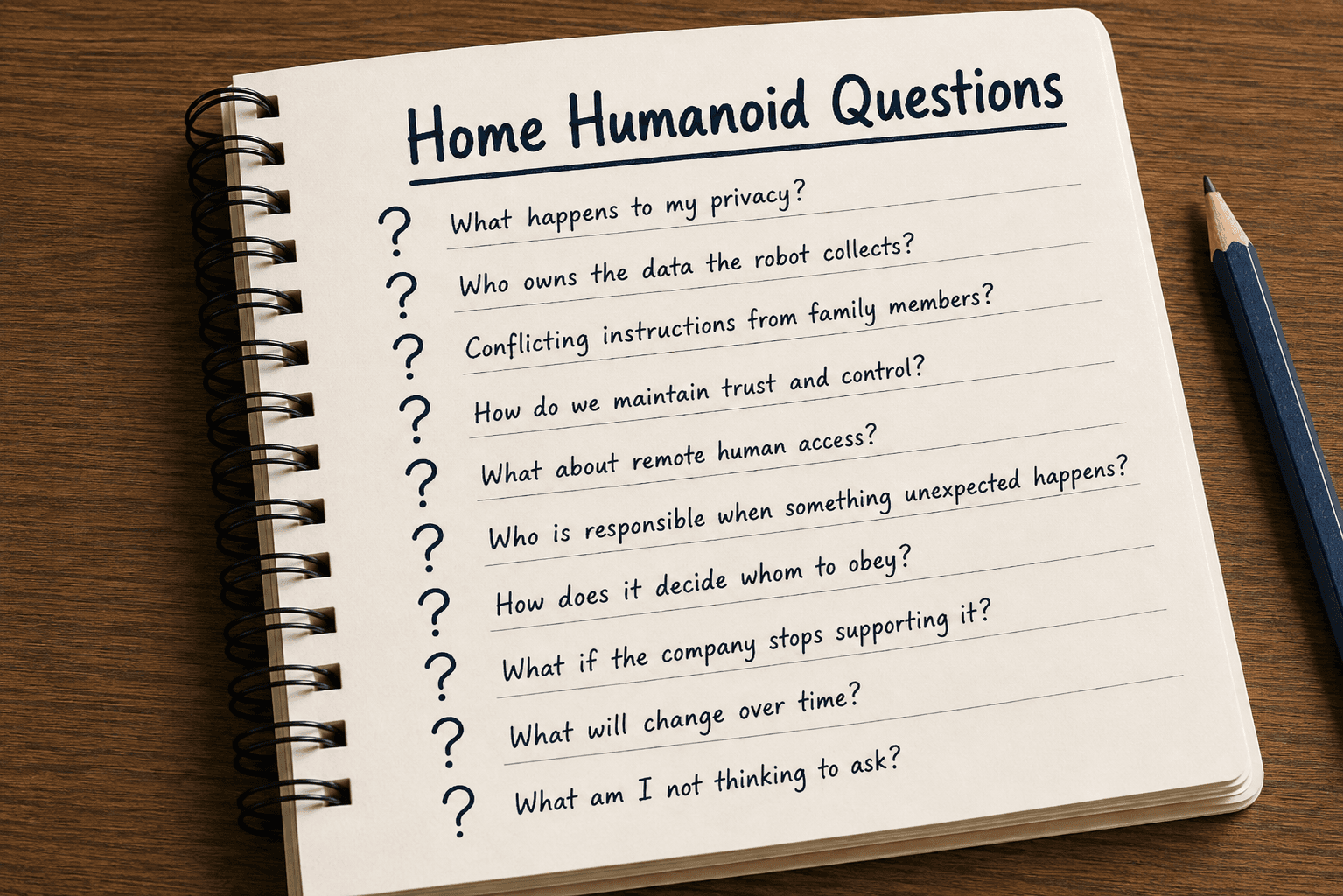
- If a remote human can take control of the robot, what can that person see and hear inside my home?
- Who owns the video, audio, room maps and behavioral data the robot collects?
- What happens if the robot loses power while carrying something heavy - or supporting a person?
- If family members give the robot conflicting instructions, how does it decide whom to obey?
- What happens to the robot if its manufacturer goes out of business or stops supporting it?
Often, the hardest part isn’t finding an answer - it’s knowing which questions to ask.
A free GPT, a specialized version of ChatGPT, can help you quickly research and explore questions specifically about humanoid robots in the home.
You can ask a question conversationally and then continue with follow-up questions based on what matters to you.
What can you ask?
Some of the most important questions are not about what a humanoid can do when everything goes right. They are about what happens when circumstances become complicated.
For example:
- What questions should I ask each company before considering a humanoid robot for an older parent?
- Can an older adult withdraw consent for monitoring even if family members believe that monitoring improves their safety?
- If a robot detects a fall but the person refuses help, what should the robot do?
- Can I see a record of every time a remote operator connected to the robot, what they accessed and why?
- What information about my household should a home robot forget automatically rather than store indefinitely?
- Can a guest ask not to be recognized, remembered, recorded or included in household summaries?
- Which capabilities could stop working if I cancel a subscription?
- If the manufacturer stops supporting the robot, what happens to its software, security updates, replacement parts and the household data it has learned?
You don’t have to know the robotics terminology before asking. You can start with a real-life concern and then dig deeper.
For example, you might ask:
- “What questions should I ask each company before considering a humanoid robot for an older parent?”
Then follow with:
- “Which of those questions are most important for privacy and remote human access?”
Or:
- “What should happen if my parent and I disagree about what the robot is allowed to monitor or report?”
A research assistant, not an oracle
Humanoid robot technology is changing rapidly. Product specifications change, timelines move, capabilities improve and new demonstrations appear constantly.
That makes source checking particularly important.
A GPT can make the research process faster and easier, but its answers should be treated as a starting point rather than the final word. Check the underlying sources, look at publication dates and distinguish between announced capabilities, controlled demonstrations and capabilities proven through repeated real-world use.
That distinction becomes especially important when the robot may eventually operate inside the most private and unpredictable environment we have: our homes.
Easy to use
The GPT is free to use within ChatGPT and does not require you to complete a lead-generation form.
If you have a question about humanoid robots in the home, open the GPT and ask it.
The easiest question to start with may be the one you haven’t thought to ask yet.
Dan Smigrod is Managing Editor of Humanoid Home News, which covers humanoid robots helping humans in the home.