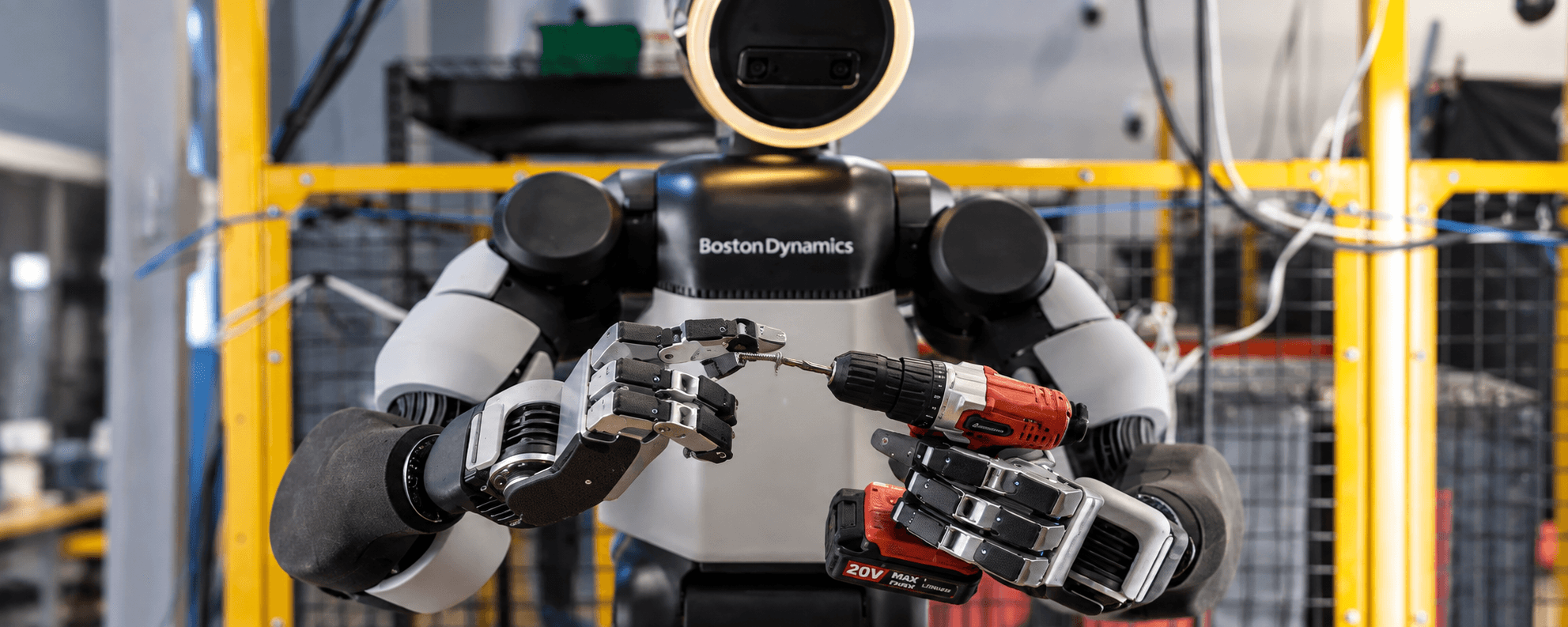

The new hand provides 13 degrees of freedom, up from seven on the previous generation. It uses direct actuation at each joint and a single actuator design across the hand, with no exposed cables crossing the joints.
The thumb has four degrees of freedom, while each of the remaining three fingers has three. The fingers can splay independently, allowing Atlas to perform pinch and tripod grasps, recover from slipping objects and operate tools with triggers, including drills, grinders, nail guns and welding torches.
Boston Dynamics has also integrated dense pressure-sensitive tactile sensors across the fingertips and palm. The sensors complement joint proprioception when Atlas performs contact-rich manipulation.
The company deliberately chose four fingers rather than replicating a five-fingered human hand. Adding a fifth finger would have required another three actuators, increasing cost, volume, power consumption and the number of components that could fail. Boston Dynamics says testing found the additional finger did not provide enough functional benefit.
The hand is approximately the size of a large human hand and is designed to preserve compatibility with manipulation data collected from people. It also supports high-fidelity simulation for training manipulation policies through reinforcement learning before transferring them to the physical robot.
Boston Dynamics says the new hand retains similar strength to its previous design and can support Atlas while carrying a loaded mini-fridge weighing more than 100 pounds.