
Agility Robotics has reached the public markets with more than 65,000 hours of real-world robot operation and over $300 million in committed Digit 5 orders. But its newly filed financials reveal the much harder challenge ahead: turning early humanoid deployments into a scalable business with sustainable unit economics.
Humanoid robotics finally has something the industry has lacked for years: a public-company financial statement.
Agility Robotics began trading on Nasdaq under the ticker AGLT on November 5, becoming what it describes as the first U.S.-listed pure-play humanoid robotics company with active commercial deployments.
Then, on November 10, Agility filed a new S-1 registration statement with the U.S. Securities and Exchange Commission.
The filing gives investors a much clearer look behind the demonstrations, customer announcements and production targets that have dominated the humanoid robotics conversation.
And the picture is fascinating.
Agility has real robots working inside customer facilities. It has accumulated tens of thousands of operating hours. It has a next-generation robot entering commercial availability in 2027. And it reports more than $300 million in committed multi-year orders.
At the same time, current revenue remains extremely small, gross margins are negative, and the company’s economics depend heavily on dramatically lowering the cost of manufacturing Digit.
That does not necessarily make Agility a weak humanoid company.
It makes Agility something potentially more useful for the entire sector:
a real-world test of whether humanoid robotics can become a sustainable business.
Revenue Is Still Tiny Compared With the Ambition
Agility generated approximately $1.78 million in total net sales in 2025, up from roughly $310,000 in 2024.
But producing and deploying those robots remained expensive.
Cost of goods sold reached approximately $4.47 million, meaning Agility recorded a gross loss of roughly $2.69 million for the year.
The company ultimately reported a $138.1 million net loss in 2025.
The first half of 2026 makes the commercialization gap even clearer.
Agility reported only about $174,000 in total net sales during the six months ended June 30, while cost of goods sold approached $3.9 million. Its net loss for the period reached approximately $361.9 million.
Taken without context, those figures look extreme.
But the net-loss figure also requires an important qualification.
A substantial part of the increase came from stock-based compensation linked to changes in the valuation of previously liability-classified awards. Agility disclosed approximately $121.4 million of such expense within selling, general and administrative costs and another $130.8 million within research and development.
Operating cash use during the first half was therefore much lower than the accounting loss, at approximately $86.2 million.
That distinction matters.
Agility is unquestionably spending heavily, but the $361.9 million accounting loss should not be interpreted as $361.9 million simply disappearing from the company’s bank account during six months.
Still, the broader message remains the same.
The humanoid business is currently consuming far more capital than it generates in revenue.
The $300 Million Order Book Is Real — but It Needs Context
Agility’s most impressive commercial number may be its reported more than $300 million in committed multi-year orders for Digit 5.
That sounds enormous beside current revenue.
The S-1 now gives investors more information about what sits behind that figure.
The orders relate to 1,000 Digit 5 robots under a three-year Robots-as-a-Service contract, with fulfillment dependent on contractual milestones, product capabilities and specifications.
That means the $300 million should not be treated like revenue already earned.
It represents potential future contract value that Agility still needs to convert into deployments.
There is another interesting detail.
The filing identifies the customer associated with the 1,000-robot agreement as a related party. Under a May 2026 agreement, Agility will also issue 453 common-stock purchase warrants for every robot sourced if the customer reaches the 1,000-robot threshold, for a potential total of 453,000 warrants.
That does not invalidate the order.
But it changes how investors should interpret it.
A large contract with one strategically aligned customer is an important commercialization signal. It is not yet evidence of broad, diversified demand across hundreds of customers.
Agility does have additional paid customer programs and deployments with companies including GXO, Schaeffler and Toyota Motor Manufacturing Canada, as well as an expanding commercial pipeline.
The next meaningful milestone will therefore be seeing whether those relationships convert into additional large-scale fleet orders.
Agility’s Strongest Number May Be 65,000 Hours
Revenue receives most of the attention because Agility is now public.
But arguably the company’s most important competitive asset is another number:
more than 65,000 hours of operation in real customer environments.
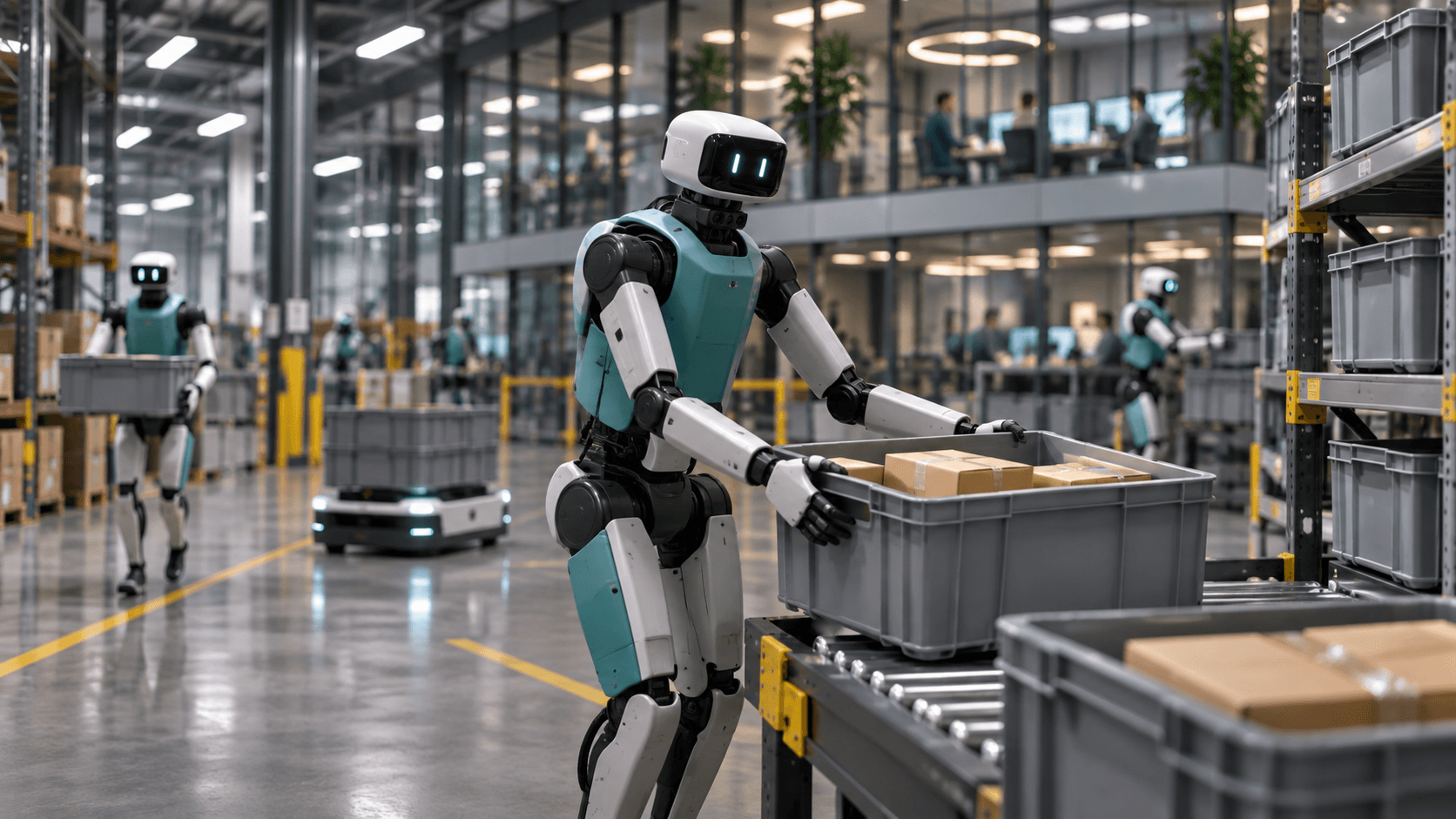
Digit has already been operating across manufacturing, logistics and distribution facilities, including work with GXO, Schaeffler and Toyota Motor Manufacturing Canada.
That matters because humanoid robotics still suffers from a demonstration problem.
A robot completing a difficult task once tells us that the task is technically possible.
A robot completing useful work thousands of times tells us something about reliability.
And industrial customers care far more about the second.
GXO’s experience is particularly useful.
At its Georgia operation, Digit has already moved more than 100,000 totes, and GXO has agreed to expand deployments into two additional U.S. facilities beginning in 2027.
Repeat deployments are stronger evidence than pilot announcements.
A customer that tests one robot may be experimenting.
A customer that expands after operating the technology has begun making an economic decision.
For humanoid robotics, that distinction could become one of the industry’s most important metrics.
The Entire Business Model Depends on Making Digit Much Cheaper
Agility’s financial future ultimately depends on a simple relationship:
how much customers will pay versus how much each robot costs Agility to build and support.
And this is where the company’s own projections become particularly interesting.
Agility says engineering and manufacturing improvements have already reduced the bill of materials for Digit 4 to approximately $125,000 per robot.
Digit 5 begins from a higher level.
Agility’s investor materials show an actual bill of materials of roughly $215,000 for a Digit 5 prototype, with engineering initiatives expected to bring that toward $150,000.
The company’s longer-term roadmap targets approximately $75,000 at annual production of 1,000 units and roughly $33,000 at 10,000 units per year.
That cost curve may be more important than almost any demonstration Digit performs over the next few years.
At $200,000-plus in manufacturing cost, a humanoid has to generate substantial productivity to justify its economics.
At $75,000, the potential customer base gets larger.
Around $30,000, the economics begin looking fundamentally different.
But those lower numbers are still targets.
Agility has to demonstrate that redesign, supplier negotiations, manufacturing learning and higher volume can actually produce those savings.
That is one of the biggest assumptions behind the company’s long-term business model.
Manufacturing Capacity Is Not the Same as Manufacturing Scale
Agility has already built infrastructure for much larger production.
Its RoboFab facility in Oregon is designed to eventually support production of up to 10,000 robots annually.
But designed capacity and actual production are two different things.
This is a distinction the humanoid industry will increasingly need to make.
A factory capable of producing 10,000 robots does not prove that 10,000 robots will be produced.
Producing 10,000 robots does not prove customers will deploy them.
And deploying 10,000 robots does not automatically prove those deployments are profitable.
The real commercial chain is longer:
manufacturing capacity must become production, production must become deployment, deployment must create customer value, and customer value must generate repeat orders.
Agility is further along that chain than many humanoid competitors.
But it has not completed it.
The RaaS Model Could Be the Key
Agility is not relying entirely on traditional robot sales.
Its strategy includes Robots-as-a-Service, or RaaS, where customers pay for the robot as an ongoing service rather than purchasing the entire system upfront.
That potentially solves one of the biggest obstacles to humanoid adoption.
Businesses may hesitate to spend hundreds of thousands of dollars purchasing an emerging technology whose useful life, maintenance requirements and future capabilities remain uncertain.
RaaS transfers more of that technology risk back to the robot manufacturer.
Customers get access without making the same upfront capital commitment.
Agility gets recurring revenue.
But that also creates a new financial challenge for Agility.
If the company has to manufacture an expensive robot upfront and recover that cost gradually through service payments, it needs significant capital and highly reliable machines.
A robot sitting idle because of maintenance problems does not simply disappoint a customer.
Under a service model, it can directly damage the economics of the contract.
That makes uptime, repair costs and useful operating hours financial metrics—not merely engineering metrics.
Digit 5 Is Where the Business Case Gets Tested
Agility’s current deployments primarily provide experience that feeds into its next major product.
Digit 5, unveiled in September, is expected to enter early customer access during the first half of 2027, with availability increasing over the following six to nine months.
The robot is designed to work safely in closer proximity to people, lift heavier loads and support a broader range of industrial tasks.
That broader capability matters commercially.
If one Digit can perform only one narrow workflow, customers may compare it directly with specialized automation.
If the same hardware can perform multiple useful jobs through different end effectors and software capabilities, the economic argument changes considerably.
This is where the promise of humanoids actually begins.
Not because they look like people.
But because a common robotic platform could potentially address tasks that previously required several different automation systems.
Digit 5 will therefore be judged on something much harder than whether it can perform impressive movements.
It needs to prove that one platform can deliver enough productive flexibility to justify its cost.
Going Public Gives Agility Something the Sector Desperately Needs: Time
Agility entered the public markets with approximately $465 million in gross capital from its business combination and related financing.
That financing matters enormously given the company’s current economics.
The S-1 notes that, as of June 30, Agility had only $14.7 million in cash and cash equivalents and expected continued losses while investing in R&D, manufacturing and commercialization.
But that balance-sheet snapshot predates the capital raised around the public listing.
The transaction therefore does more than give investors access to the company.
It gives Agility additional runway to move Digit 5 from prototype production into commercial deployments.
That may be exactly what the company needs.
Humanoid robotics is not likely to become profitable through a handful of robot sales.
The economics improve only if manufacturing costs fall, deployment processes become repeatable and fleets become significantly larger.
Capital buys Agility time to attempt that transition.
Agility May Become the Humanoid Industry’s Public Benchmark
This could ultimately be the most significant consequence of Agility’s Nasdaq listing.
Private humanoid companies can disclose selected metrics.
They can announce funding rounds, partnerships, production targets and customer agreements without revealing the complete financial picture.
Agility no longer has that luxury.
Public investors will eventually see revenue.
Gross margins.
Operating expenses.
Cash consumption.
Customer concentration.
Production progress.
And whether promised orders actually convert into recognized revenue.
That transparency could make Agility a benchmark for the wider humanoid robotics industry.
If Digit deployments scale and manufacturing costs decline as planned, public markets will receive evidence that humanoids can become a financially viable category.
If those economics prove more difficult, investors may begin applying greater skepticism to similarly ambitious projections from private competitors.
Either outcome gives the industry useful information.
The Most Important Humanoid Competition May Now Be Economic
For years, humanoid robots have competed visually.
Who walks better?
Who runs faster?
Who has better hands?
Who can perform the most impressive demonstration?
Agility’s public listing introduces a different scoreboard.
How much does the robot cost to build?
How many productive hours does it deliver?
How much revenue does each deployment generate?
How quickly can manufacturing costs decline?
Do customers expand their fleets?
And ultimately, can the company make money doing it?
Agility has already crossed several hurdles that many competitors have not.
Digit is working in real customer environments. Customers have expanded deployments. The company has manufacturing infrastructure and significant new capital.
But its S-1 also makes clear how much commercialization remains ahead.
That is precisely why Agility may be one of the most important humanoid companies to watch now.
Not because going public proves that humanoid robotics works as a business.
Because for the first time, public investors will get to watch a humanoid company try to prove it with numbers.